 Indietro
Proteins Required for DNA Synthesis
 05:10

Termini in questo insieme (20)
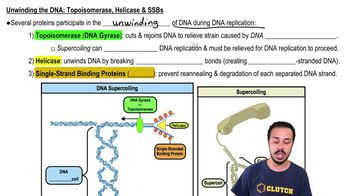
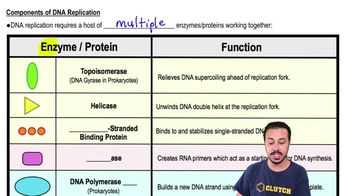
DNA helicase unwinds the double-stranded DNA by breaking hydrogen bonds between base pairs, creating the replication fork.
SSB proteins bind to single-stranded DNA to prevent it from re-annealing or forming secondary structures.
Primase synthesizes a short RNA primer that provides a starting point for DNA polymerase to begin DNA synthesis.
DNA polymerase adds nucleotides to the 3' end of the RNA primer, synthesizing the new DNA strand complementary to the template strand.
DNA ligase joins Okazaki fragments on the lagging strand by forming phosphodiester bonds, sealing nicks in the sugar-phosphate backbone.
The sliding clamp holds DNA polymerase firmly onto the DNA template, increasing the enzyme's processivity during synthesis.
Topoisomerase relieves the supercoiling tension ahead of the replication fork by cutting and rejoining DNA strands.
The RNA primer provides a free 3'-OH group for DNA polymerase to start adding DNA nucleotides.
DNA polymerase I (in prokaryotes) or RNase H (in eukaryotes) removes RNA primers and replaces them with DNA nucleotides.
Both strands use similar proteins, but the lagging strand requires repeated primase activity and DNA ligase to join Okazaki fragments.
DNA polymerase has proofreading 3' to 5' exonuclease activity to remove incorrectly paired nucleotides.
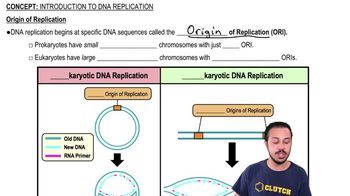
The ORC binds to the origin of replication to initiate the assembly of the replication machinery.
RPA stabilizes single-stranded DNA during replication, similar to SSB in prokaryotes.
DNA polymerase epsilon synthesizes the leading strand in eukaryotic DNA replication.
DNA polymerase delta synthesizes the lagging strand in eukaryotic DNA replication.
FEN1 removes RNA primers and flaps during lagging strand synthesis before ligation.
The clamp loader loads the sliding clamp onto DNA to enable DNA polymerase processivity.
Telomerase extends telomeres at chromosome ends to prevent shortening during replication.
Each new DNA molecule contains one original strand and one newly synthesized strand, ensuring genetic continuity.
DNA polymerase can only add nucleotides to the 3' end, so synthesis proceeds in the 5' to 3' direction.