 Indietro
Protists and Plant Diversity in General Biology
 03:23

Termini in questo insieme (29)
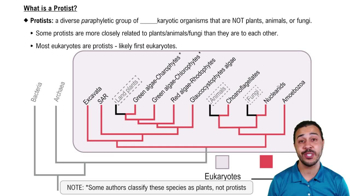
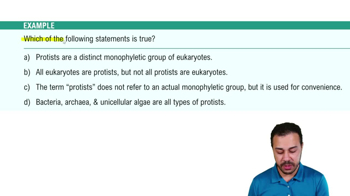
A protist is an informal term for eukaryotes that are not plants, animals, or fungi, often unicellular and diverse in structure and function.
Eukaryotic cells have a nucleus and other membrane-enclosed organelles, making them more complex than prokaryotic cells.
Endosymbiosis is the process where a eukaryotic cell engulfed a photosynthetic bacterium, leading to plastid evolution and the diversity of protists.
The four supergroups are Excavata, SAR, Archaeplastida, and Unikonta.
Excavata includes diplomonads, parabasalids, and euglenozoans.
They lack plastids, have reduced mitochondria, and mostly live in anaerobic environments.
A kinetoplast is an organized mass of DNA within a single mitochondrion.
SAR is a monophyletic group including Stramenopiles, Alveolates, and Rhizarians, defined by DNA similarities.
Diatoms are unicellular algae with silica walls; they are major photosynthetic organisms affecting global CO2 levels.
Brown algae are large multicellular marine algae with carotenoid pigments, plantlike structures, and lack true tissues.
A life cycle with multicellular haploid gametophytes and diploid sporophytes alternating.
Oomycetes have cellulose cell walls, not chitin, and are related to plastid-bearing groups but lack plastids.
Alveolates have membrane-enclosed sacs called alveoli under the plasma membrane.
Dinoflagellate blooms cause red tides, which are toxic and can kill marine life, worsened by ocean warming.
Apicomplexans are animal parasites with complex organelles for host penetration, including malaria-causing Plasmodium.
Ciliates reproduce asexually by binary fission and generate variation by conjugation exchanging micronuclei.
Rhizarians are amoebas with threadlike pseudopodia used for movement and feeding.
Green algae, especially charophytes, are the closest relatives of plants.
Alternation of generations, walled spores produced in sporangia, and apical meristems.
Apical meristems are localized regions of cell division at root and shoot tips enabling growth.
Bryophytes are nonvascular plants (mosses, liverworts, hornworts) with dominant haploid gametophytes.
Mosses colonize soils, retain nitrogen, and Sphagnum moss forms peat that stores large carbon amounts.
They have vascular tissue but do not produce seeds; include lycophytes and monilophytes (ferns).
Xylem conducts water and minerals; phloem transports organic nutrients like sugars.
Microphylls are small leaves with a single vein; megaphylls are larger leaves with branched vascular systems.
Homosporous plants produce one spore type; heterosporous plants produce two spore types leading to male or female gametophytes.
Slime molds are amoebozoans with fruiting bodies; two lineages are plasmodial and cellular slime molds.
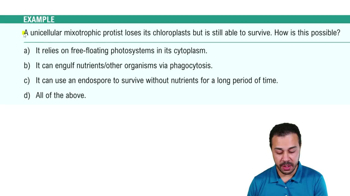
Protists can be mutualistic symbionts (e.g., dinoflagellates in corals) or parasites (e.g., Plasmodium causing malaria).
They are primary producers, forming phytoplankton that support marine food webs and influence the global carbon cycle.