Indietro

Repaso examen 2

I pulsanti di controllo sono stati cambiati in modalità "navigazione".
1/21
  • What unique bonding property does carbon have?

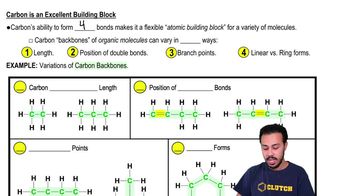
    Carbon has four valence electrons allowing it to form four covalent bonds with various atoms, enabling the creation of large, complex molecules.
  • What shapes do carbon molecules form with single and double bonds?

    Carbon atoms with single bonds form tetrahedral shapes, while double bonds create planar molecules.
  • What are hydrocarbons?

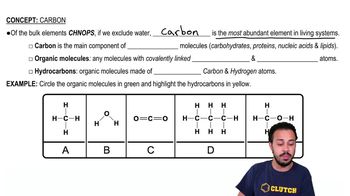
    Hydrocarbons are organic molecules made only of carbon and hydrogen, often found in fats and capable of releasing large amounts of energy.
  • Define isomers and their types.

    Isomers have the same molecular formula but different structures: structural isomers differ in covalent arrangements, geometric isomers differ in spatial arrangement around double bonds, and enantiomers are mirror images.
  • Why are enantiomers important biologically?

    Enantiomers can have different biological effects; organisms are sensitive to molecular differences, making them crucial in pharmaceuticals.
  • What are functional groups in organic molecules?

    Functional groups are specific molecular components attached to carbon skeletons that determine chemical reactivity and properties.
  • List the six most common functional groups in organic molecules.

    Hydroxyl (-OH), Carbonyl (C=O), Carboxyl (-COOH), Amino (-NH2), Sulfhydryl (-SH), Phosphate (-OPO3^2-), and Methyl (-CH3).
  • What is the role of the hydroxyl group?

    The hydroxyl group (-OH) makes molecules polar and soluble in water; compounds with it are called alcohols.
  • Difference between ketone and aldehyde groups?

    Both contain a carbonyl group (C=O); ketones have it within the carbon skeleton, aldehydes have it at the end.
  • What is the significance of the carboxyl group?

    The carboxyl group (-COOH) acts as an acid by donating H+, found in organic acids like acetic acid.
  • What is the function of the amino group?

    The amino group (-NH2) acts as a base, accepting H+, and is found in amino acids.
  • Describe the sulfhydryl group and its importance.

    The sulfhydryl group (-SH) stabilizes protein structure by forming disulfide bonds.
  • What role does the phosphate group play in cells?

    The phosphate group (-OPO3^2-) is involved in energy transfer, as in ATP, and in nucleic acids.
  • What is the methyl group and its effect on molecules?

    The methyl group (-CH3) affects gene expression and molecule shape by adding nonpolar character.
  • What is ATP and its role in cells?

    Adenosine triphosphate (ATP) is the primary energy carrier in cells, transferring energy through breaking phosphate bonds.
  • What is a dehydration reaction in polymer formation?

    A dehydration reaction links monomers by removing water, forming a new covalent bond.
  • What is hydrolysis in biological molecules?

    Hydrolysis breaks bonds in polymers by adding water, separating monomers.
  • What are monosaccharides and their types?

    Monosaccharides are simple sugars classified by carbon number: trioses (3C), pentoses (5C), and hexoses (6C).
  • Difference between glucose and fructose?

    Glucose is an aldose sugar with an aldehyde group; fructose is a ketose sugar with a ketone group.
  • What is a glycosidic linkage?

    A glycosidic linkage is a covalent bond formed between two sugar molecules during dehydration.
  • What are polysaccharides and examples?

    Polysaccharides are long carbohydrate chains; examples include starch, glycogen, cellulose, and chitin.