Indietro

Scientific Method and Process of Science

I pulsanti di controllo sono stati cambiati in modalità "navigazione".
1/20
  • What are the five characteristics shared by all living things?

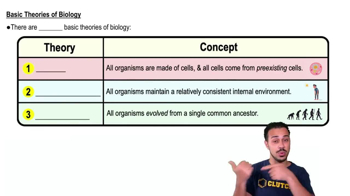
    • Composed of cells
    • Replication/Reproduction
    • Information processing
    • Energy use
    • Evolution
  • What is the Cell Theory?

    All living organisms are made of cells, and all cells come from preexisting cells of the same type.
  • What was Louis Pasteur's experiment and its significance?

    Pasteur used swan-neck flasks to disprove spontaneous generation, showing that new cells come from preexisting cells.
  • What is the Chromosome Theory of Inheritance?

    Hereditary information is encoded in chromosomes, which are made of DNA and proteins; genes are segments of DNA.
  • What is the Central Dogma of Biology?

    Information flows from DNA to RNA to protein through replication, transcription, and translation.
  • What is ATP and its role in cells?

    ATP (adenosine triphosphate) is the universal energy molecule in cells, releasing energy when its phosphoanhydride bonds are broken.
  • What is evolution in biological terms?

    Evolution is a change in the characteristics of a population over time, driven by genetic variation and natural selection.
  • What are the two requirements for natural selection?

    • Individuals vary in heritable traits
    • Traits affect reproductive success
  • What is fitness in evolutionary biology?

    Fitness is the ability of an individual to produce offspring; higher fitness means more offspring.
  • What is a phylogenetic tree?

    A diagram showing evolutionary relationships between species based on common ancestry and genetic similarity.
  • What are the three domains of life?

    Bacteria, Archaea (both prokaryotes), and Eukarya (organisms with a nucleus).
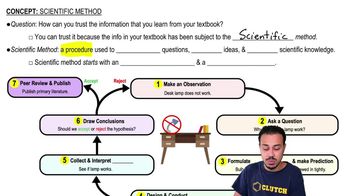
  • What is a scientific hypothesis?

    A tentative, testable, and falsifiable explanation for an observation.
  • How does a scientific theory differ from a hypothesis?

    A theory unifies many hypotheses, has broad scope, and is highly supported by evidence.
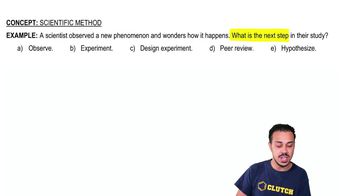
  • What is the scientific method?

    A cyclical process involving observation, question, hypothesis, prediction, testing, and conclusion.
  • Why is peer review important in science?

    It ensures experimental design is sound and conclusions are legitimate by independent evaluation.
  • What is the difference between experimental and observational studies?

    Experimental studies manipulate variables; observational studies compare groups without manipulation.
  • What is a control group in an experiment?

    A group not receiving the treatment, used for comparison to control confounding variables.
  • What are confounding variables?

    Factors other than the independent variable that can affect the dependent variable and bias results.
  • What is the importance of sample size in studies?

    Larger sample sizes increase confidence that results are not due to random chance.
  • What is the difference between correlation and causation?

    Correlation is a relationship between variables; causation means one variable causes the other.