Indietro

sep 21

I pulsanti di controllo sono stati cambiati in modalità "navigazione".
1/21
  • What is a molecule?

    A molecule is two or more atoms bound together by covalent bonds.
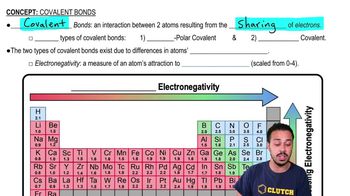
  • Define electronegativity.

    Electronegativity is an atom's measure of attraction for shared electrons.
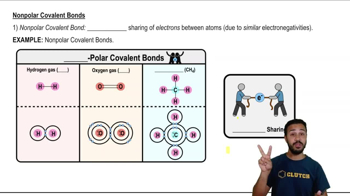
  • What characterizes nonpolar covalent bonds?

    Nonpolar covalent bonds share electrons equally because the two atoms have the same electronegativity.
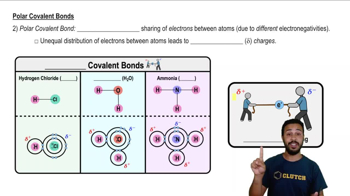
  • What are polar covalent bonds?

    Polar covalent bonds occur when electrons are pulled closer to the more electronegative atom, creating partial positive and negative charges.
  • Why is oxygen often involved in polar covalent bonds?

    Oxygen is highly electronegative and almost always forms polar covalent bonds.
  • What happens in an ionic bond?

    One atom strips an electron from another, creating ions with opposite charges that attract each other.
  • Describe the ionic bond formation between sodium (Na) and chlorine (Cl).

    Na donates one electron to Cl, forming Na+ and Cl- ions, which are held together by opposite charges.
  • What is a salt in chemistry?

    A salt is any ionic compound, often strong and hard when dry but dissolves easily in water.
  • What are hydrogen bonds?

    Hydrogen bonds are weak bonds involving hydrogen atoms attracted to electronegative atoms like oxygen or nitrogen.
  • How do hydrogen bonds form in water?

    Water's polar covalent bonds create partial charges, allowing hydrogen atoms to form hydrogen bonds with oxygen atoms of other water molecules.
  • What is a chemical reaction?

    A chemical reaction involves breaking existing bonds and forming new ones, converting reactants into products.

    reactants starting materials

    products The materials that result from the chemical reaction

  • Write the balanced chemical equation for photosynthesis.

    6 CO2 + 6 H2O → C6H12O6 + 6 O2
  • Define cohesion in water.

    Cohesion is the tendency of water molecules to stick together due to hydrogen bonding.
  • What is adhesion in the context of water?

    Adhesion is water's ability to cling to other substances, like cell walls, helping them stay hydrated.

  • Explain surface tension in water.

    Surface tension measures how difficult it is to stretch or break the surface of a liquid, caused by cohesive forces.
  • What is thermal energy?

    Thermal energy is the energy associated with the random movement of atoms and molecules.
  • How does water moderate temperature?

    Water absorbs and releases large amounts of heat by breaking and forming hydrogen bonds, stabilizing temperatures.
  • What is evaporative cooling?

    When the hottest molecules evaporate, the remaining liquid cools down, a process called evaporative cooling.
  • Why is water important for Earth's temperature regulation?

    Water stores heat during warm periods and releases it during cool periods, stabilizing Earth's climate and ocean temperatures.
  • How does water's polarity affect its interactions?

    Water's polarity allows it to form hydrogen bonds, leading to cohesion, adhesion, and solvent properties essential for life.
  • what is a balanced chemical equation


    The same number of atoms on both sides of the equation