Indietro

sep 28

I pulsanti di controllo sono stati cambiati in modalità "navigazione".
1/26
  • What are lipids and their general properties?

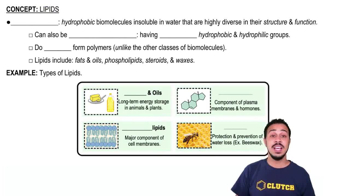
    Lipids are hydrophobic macromolecules that do not mix well with water, may have small hydrophilic regions, are the smallest macromolecules, and are not polymers made of monomers.

    3 important types, fats - phospholipids, steroids

  • What are the three important types of lipids?

    Fats, phospholipids, and steroids are the three important types of lipids.
  • What is the structure of a fat (triglyceride)?

    A fat consists of 3 fatty acids linked to a glycerol molecule. Fatty acids have a carboxyl group bound to a hydrocarbon chain.

    glycerol: small sugar

  • Difference between saturated and unsaturated fatty acids?

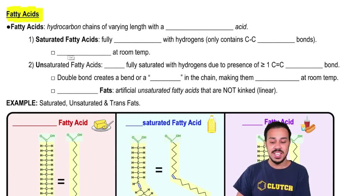
    Saturated fatty acids have only single bonds and maximum hydrogen atoms, making them solid at room temperature. Unsaturated fatty acids have one or more double bonds causing kinks or bends and are liquid at room temperature.

  • What is the main function of fats in organisms?

    The main function of fats is energy storage. A gram of fat stores twice as much energy as a gram of carbohydrates.
  • What are phospholipids and their role?

    Phospholipids are major components of cell membranes, composed of glycerol, two fatty acid chains, and a phosphate group. They form bilayers with hydrophilic heads outside and hydrophobic tails inside.
  • Describe the structure of steroids.

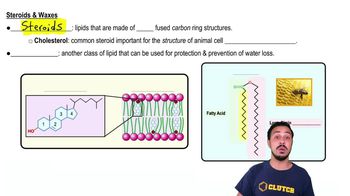
    Steroids have a carbon skeleton of 4 fused rings. Different steroids vary by chemical groups attached. Example: cholesterol, a precursor for sex hormones ;)

  • What is a protein and its general role?

    A protein is a polymer of amino acids and performs diverse functions including enzymes, transport, defense, signaling, structural support, and storage.
  • List some roles of proteins in the body.

    Enzymes speed up reactions transport proteins move nutrients defense proteins include antibodies, signaling proteins are hormones and chemical messengers receptor proteins receive signals contractile proteins make up tendons and structural proteins provide support storage proteins Supply amino acids

  • What determines a protein's function?

    Function of the protein depends on its structure•

    Each protein has a specific, unique shape•

    Proteins must recognize and bind to other molecules to function

  • What is denaturation in proteins?

    Denaturation is the process where a protein unravels and loses its shape and function, often caused by heat or environmental changes.
  • What are amino acids and their general structure?

    Amino acids have an amino group, a carboxyl group, and a variable R group attached to a central carbon.
  • How do amino acids differ in polarity?

    Amino acids with non-polar R groups are hydrophobic, while those with polar or charged R groups are hydrophilic.
  • What is a peptide bond?

    A peptide bond is formed by a dehydration reaction between the carboxyl group of one amino acid and the amino group of another.
  • What is the difference between a dipeptide and a polypeptide?

    A dipeptide consists of two amino acids linked by a peptide bond, while a polypeptide is a longer chain of amino acids.
  • Why are polypeptides not complete proteins?

    Polypeptides must be folded into a specific 3D shape influenced by R groups to become functional proteins.
  • What are the four levels of protein structure?

    The four levels are primary (amino acid sequence), secondary (local folding like alpha helices), tertiary (overall 3D shape), and quaternary (multiple polypeptide subunits).
  • Describe the primary structure of a protein.

    The primary structure is the linear sequence of amino acids in a polypeptide chain.
  • What stabilizes secondary protein structures?

    Secondary structures like alpha helices and beta sheets are stabilized by hydrogen bonds between backbone atoms.
  • What stabilizes tertiary protein structure?

    The tertiary structure is stabilized by interactions between R groups, including hydrophobic interactions, hydrogen bonds, and disulfide bridges.
  • What is quaternary protein structure?

    The quaternary structure forms when multiple polypeptide subunits associate to form a functional protein.
  • unsaturated fatty acid


    • Fats of most plants and fish• Kinks in the fatty acid chains• Liquid at room temperature

  • Saturated fatty acids


    • Most animal fats• No bends in the fatty acid chains• Solid at room temperature

  • Partially hydrogenated oils


    Unsaturated fats that have been converted to saturated fats

  • whats is globular proteins


    Most enzymes and many other proteins• Example: Lysozyme

  • whats fibrous proteins


    Most enzymes and many other proteins• Example: Lysozyme