Indietro

sep25

I pulsanti di controllo sono stati cambiati in modalità "navigazione".
1/26
  • What determines the properties of organic compounds?

    The properties depend on the size and shape of the carbon skeleton, including length, branching, double bonds, rings, and attached atoms.
  • What is a chemical group in organic molecules?

    A chemical group is a set of atoms attached to the carbon skeleton that affects the molecule's function.
  • How do testosterone and estradiol differ?

    They have the same carbon skeleton but differ in their chemical groups, which changes their function.
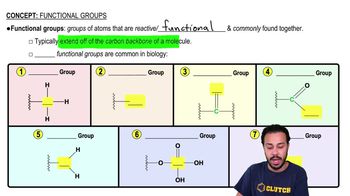
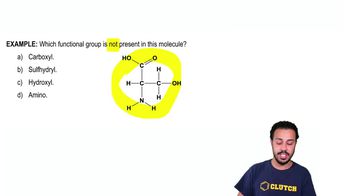
  • What is the hydroxyl group and an example molecule?

    The hydroxyl group is an H atom bonded to an O atom (-OH). Example: Alcohols.
  • Describe the carbonyl group and where it is found.

    A carbonyl group is a carbon double bonded to oxygen (C=O), found in simple sugars.
  • What is the carboxyl group and its effect in solution?

    The carboxyl group (-COOH) donates an H+ to solution, making it acidic.
  • What is the amino group and its behavior in solution?

    The amino group (-NH2) picks up an H+ from solution and is called an amine.
  • Describe the phosphate group and its charge.

    The phosphate group (PO4^3-) has a phosphorus atom bonded to four oxygens, often ionized with negative charges.
  • What is the methyl group and its biological role?

    The methyl group (-CH3) is nonpolar, hydrophobic, and affects gene expression. its C bonded with 3 H atoms.

  • Which chemical groups are polar and hydrophilic?

    Hydroxyl, carbonyl, carboxyl, amino, and phosphate groups are polar and hydrophilic.
  • Which chemical group is nonpolar and hydrophobic?

    The methyl group is nonpolar, hydrophobic, and affects molecular shape.
  • What are macromolecules and polymers?

    Macromolecules are very large molecules made of polymers, which are small molecules joined together in chain

  • What is a dehydration reaction?

    A dehydration reaction Removes a molecule of water as two molecules become bonded together.

    OH- from one molecule, H+ from the other molecule

  • What is hydrolysis?

    Hydrolysis breaks polymers into monomers by adding water, the opposite of dehydration.

    OH- attaches to one monomer and H+ attaches to the other monomer

  • What role do enzymes play in polymer reactions?

    Enzymes speed up dehydration and hydrolysis reactions in cells.
  • What are monosaccharides?

    Monosaccharides are the simplest sugars, usually with a formula multiple of CH2O, e.g., glucose (C6H12O6).
  • What is the difference between glucose and fructose?

    They are isomers with the same formula but different structures; glucose has an aldehyde group, fructose a ketone.
  • How do monosaccharides typically exist structurally?

    Most monosaccharides with 3-7 carbons form ring structures, especially pentoses and hexoses.
  • What are disaccharides? Give examples.

    Disaccharides are two monosaccharides linked by dehydration, e.g., maltose (two glucose) and sucrose (glucose + fructose).
  • What are polysaccharides and their functions?

    Polysaccharides are long chains of monosaccharides used for storage (starch, glycogen) and structure (cellulose, chitin).
  • Describe starch and its biological role.

    Starch is a plant storage polysaccharide, helical and branched or unbranched, hydrolyzed by amylase in animals.
  • What is glycogen and where is it stored?

    Glycogen is an animal glucose storage polysaccharide, highly branched, stored mainly in liver and muscle cells.
  • What is cellulose and its significance?

    Cellulose is a glucose polymer forming cable-like microfibrils in plant cell walls; most abundant organic compound on Earth.
  • Can animals digest cellulose?

    Most animals cannot digest cellulose; it acts as insoluble fiber, but some microorganisms can hydrolyze it.
  • What is chitin and its biological role?

    Chitin is a structural polysaccharide in insect and crustacean exoskeletons and fungal cell walls.
  • what is monomers


    The building blocks of polymers