Skip to main content
General Biology
Il mio corso
Impara
Preparazione agli esami
AI Tutor
Guide di studio
Soluzioni per libri di testo
Flashcard
Esplora
Prova l'app
Il mio corso
Impara
Preparazione agli esami
AI Tutor
Guide di studio
Soluzioni per libri di testo
Flashcard
Esplora
Prova l'app
Indietro
Species Concepts and Speciation in General Biology
Puoi toccare per girare la carta.
Species concept used by early taxonomists
Puoi toccare per girare la carta.
👆
Species concept used by early taxonomists
The
morphological species concept
was likely used, classifying species based on physical appearance of preserved specimens.
Avanzamenti del tracciato
I pulsanti di controllo sono stati cambiati in modalità "navigazione".
1/21
Video consigliati
VideoThumbView.guidedCourse
03:03
Introduction to Speciation
4468
views
116
rank
Termini in questo insieme (21)
Nascondere definizioni
Species concept used by early taxonomists
The
morphological species concept
was likely used, classifying species based on physical appearance of preserved specimens.
Species concept incorporating reproductive compatibility
The
biological species concept
defines species by their ability to interbreed and produce fertile offspring.
Species concept using molecular and cladistic data
The
phylogenetic species concept
uses genetic data to identify the smallest group sharing a common ancestor.
Historical species concept applied to Galapagos tortoises
Subspecies were recognized based on potential interbreeding, reflecting the
biological species concept
.
Current species concept applied to Galapagos tortoises
Molecular data supports recognizing each tortoise population as a separate species under the
phylogenetic species concept
.
Mode of speciation for Galapagos tortoises
Allopatric speciation
due to geographic isolation on different islands or volcanic craters.
Mechanisms causing population change after isolation
Mechanisms include
mutation, natural selection, genetic drift, and gene flow
, leading to genetic divergence.
Prezygotic reproductive barriers
Barriers preventing fertilization, such as
temporal, habitat, behavioral, mechanical, and gametic isolation
.
Postzygotic reproductive barriers
Barriers after fertilization, including
reduced hybrid viability, reduced hybrid fertility, and hybrid breakdown
.
Temporal isolation example
Species reproduce at different times, preventing mating.
Behavioral isolation example
Differences in mating behaviors prevent interbreeding.
Hybrid zone allele frequency expectation
Allele frequencies gradually change across the hybrid zone, showing a cline from one species to the other.
Outcome of hybrid zone with no hybrids after 40 years
Likely
reinforcement
, where natural selection strengthens reproductive barriers to prevent hybridization.
Reinforcement in hybrid zones
Selection against hybrids increases reproductive isolation between species.
Fusion in hybrid zones
Two species merge into one due to extensive gene flow and lack of reproductive barriers.
Stability in hybrid zones
Hybrids continue to be produced and coexist with parent species over time.
Fundamental niche
The full range of environmental conditions where a species can survive and reproduce without competition.
Realized niche
The actual conditions and areas a species occupies due to competition and other biotic factors.
Competitive exclusion principle
Two species competing for the same resources cannot coexist indefinitely; one will outcompete the other.
Character displacement
Evolutionary change in species traits that reduces competition when species coexist.
Effect of removing A. distichus on A. insolitus niche
A. insolitus expanded its realized niche to open areas and showed morphological changes due to reduced competition.
 IndietroIndietro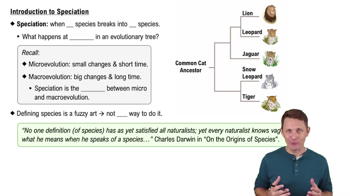
 03:03
03:03