 Indietro
Themes of Biology and Scientific Method
 09:26
09:26
Termini in questo insieme (20)
Biology is the study of life and living organisms.
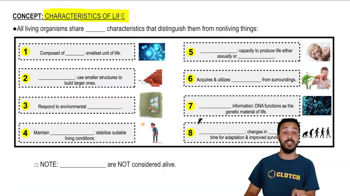
Order, Grow/Develop, Respond/Adapt, Evolve, Process Energy, Reproduce.
All living things are made of cells, cells are the basic unit of life, and all cells come from pre-existing cells.
Prokaryotes lack a nucleus and membrane-bound organelles; Eukaryotes have a nucleus and membrane-bound organelles.
Chemical level, Cells, Tissues, Organs/Systems, Organisms, Populations, Communities, Ecosystems, Biosphere.
A defined area including all living and non-living components interacting together.
Evolution explains the unity and diversity of life by changes in species over time.
The classification of living things into groups based on similarities, organized from broad to specific.
Scientific names use two words: the first is the genus, the second is the species (e.g., Homo sapiens).
To provide a universal, standardized naming system that avoids confusion.
A testable prediction or explanation that begins a scientific study.
The variable that is changed or tested to observe its effect.
The variable that is measured or observed as a result of changes in the independent variable.
All other factors kept constant to ensure a fair test between control and experimental groups.
Control group lacks the independent variable; experimental group includes it.
An explanation supported by overwhelming scientific evidence explaining observed facts.
An observation describing what happens and predicting future events under certain conditions.
He disproved spontaneous generation and developed pasteurization to kill contaminants without altering substances.
The process of heating a substance enough to kill harmful microbes without changing its properties.
They allow testing one variable at a time to determine cause and effect accurately.