Why do hydrogen atoms in a water molecule carry a partial positive charge?
Because oxygen is more electronegative than hydrogen, shared electrons are pulled more toward oxygen, creating partial negative charge on oxygen and partial positive charges on hydrogens.
What type of bond holds water molecules together?
Hydrogen bonds form between the partial positive hydrogen of one water molecule and the partial negative oxygen of another, creating weak but important attractions.
How does water's polarity affect its interactions?
Water's polar covalent bonds create an uneven charge distribution, allowing it to form hydrogen bonds and interact with other polar molecules.
What is the role of hydrogen bonds in biological molecules?
Hydrogen bonds stabilize and organize biological molecules, providing flexibility for processes like DNA replication and protein folding.
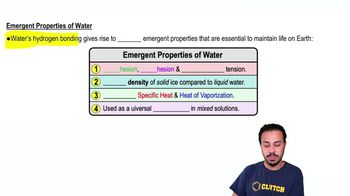
How do cohesion and adhesion contribute to water transport in plants?
Cohesion causes water molecules to stick together, and adhesion helps water stick to cell walls, enabling water to move upward against gravity in xylem.
What causes water's high surface tension?
Interfacial hydrogen bonding at the water-air interface creates a net inward pull, resulting in high surface tension that supports organisms like water striders.
Why does water have a high specific heat?
Because energy must first break hydrogen bonds before increasing molecular motion, water absorbs a lot of heat with little temperature change.
How does evaporative cooling work in organisms?
Water molecules with the highest kinetic energy evaporate, removing heat and cooling the surface, helping organisms regulate temperature.
Why does ice float on liquid water?
Hydrogen bonds lock water molecules into a spacious crystalline lattice in ice, making it less dense than liquid water.
What is a hydration shell?
A hydration shell is a sphere of water molecules surrounding an ion or polar molecule, allowing it to dissolve in water.
What is the difference between hydrophilic and hydrophobic substances?
Hydrophilic substances have an affinity for water and dissolve easily, while hydrophobic substances repel water and do not mix.
How does water act as a versatile solvent in biological systems?
Water dissolves polar and ionic substances by forming hydration shells, facilitating chemical reactions and nutrient transport.
How is concentration of solutes commonly expressed in biology?
Concentration is often expressed as percent solutions, which is grams of solute per 100 milliliters of solution.
What is a mole in chemistry?
A mole is a unit representing 6.02 × 10^23 molecules, allowing scientists to count molecules consistently across substances.
How is molarity defined?
Molarity (M) is the number of moles of solute dissolved per liter of solution.
What happens when water molecules dissociate?
Water molecules dissociate into hydrogen ions (H+) and hydroxide ions (OH-), which are reactive and influence pH.
 Indietro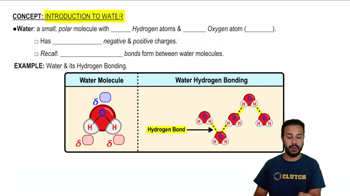
 01:54
01:54