 Indietro
Water and Its Properties in General Biology
 01:54
01:54
Termini in questo insieme (23)
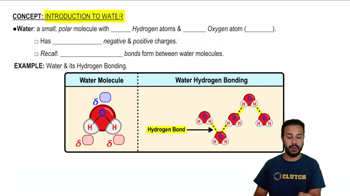
Oxygen attracts electrons more strongly than hydrogen, giving oxygen a partial negative charge (δ−) and hydrogens partial positive charges (δ+), resulting in uneven charge distribution.
Water's polarity causes partial charges that attract other water molecules, forming weak hydrogen bonds between them.
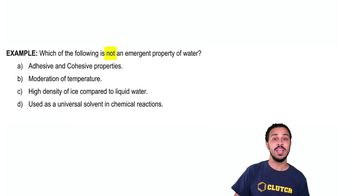
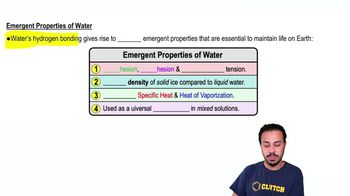
Cohesive behavior, ability to moderate temperature, expansion upon freezing, and versatility as a solvent.
Cohesion is water molecules sticking to other water molecules via hydrogen bonds, giving water high surface tension.
Adhesion is water sticking to non-water surfaces, while cohesion is water molecules sticking to each other.
Because hydrogen bonds require a lot of energy to break and form, water absorbs or releases heat slowly, resisting temperature changes.
Specific heat is the heat needed to raise 1 gram of a substance by 1°C; water has a high specific heat, helping stabilize temperatures in organisms and environments.
When water freezes, it forms a crystal lattice that spaces molecules farther apart, making ice less dense than liquid water.
A solution is a homogeneous mixture; the solute is the substance dissolved, and the solvent is the substance doing the dissolving.
Water's polarity allows it to dissolve many ionic and polar substances by surrounding and separating their ions or molecules.
A layer of water molecules surrounding a dissolved ion, keeping ions separated and dissolved.
Hydrophilic substances interact well with water and often dissolve; hydrophobic substances do not interact well and usually do not dissolve.
Molecular mass is the total mass of all atoms in a molecule, calculated by adding the atomic masses of each atom in the molecular formula.
A mole is a unit representing 6.02 × 10²³ particles, used to count atoms, molecules, or other particles.
Molarity (M) is the concentration of a solution, calculated as moles of solute divided by liters of solution: \(M=\frac{\text{moles of solute}}{\text{liters of solution}}\).
Water reversibly breaks into hydroxide ions (OH⁻) and hydronium ions (H₃O⁺ or H⁺), maintaining dynamic equilibrium.
Acids increase H⁺ concentration (more acidic), while bases decrease H⁺ concentration (more basic).
The pH scale (0–14) measures acidity or basicity based on H⁺ concentration; lower pH means more acidic, higher pH means more basic.
Strong acids/bases completely dissociate in water; weak acids/bases partially dissociate and can reverse the reaction.
In any aqueous solution, \([H^+][OH^-]=10^{-14}\), maintaining balance between acidity and basicity.
Buffers resist changes in pH by reacting with added acids or bases, maintaining stable conditions necessary for biological functions.
Increased atmospheric CO₂ dissolves in seawater forming carbonic acid, lowering ocean pH and reducing carbonate availability for marine organisms.
Lower carbonate levels impair calcification, affecting organisms like coral reefs and mollusks that rely on calcium carbonate structures.