Polar covalent bonds in water create partial charges, where the oxygen atom has a partial negative charge and hydrogen atoms have partial positive charges, allowing hydrogen bonds to form between molecules.
What is the shape and composition of a water molecule?
A water molecule has a bent (V) shape with two hydrogen atoms and one oxygen atom joined by polar covalent bonds.
Why is water a polar molecule?
Because oxygen is more electronegative than hydrogen, it pulls shared electrons closer, creating partial positive and negative charges on opposite ends.
Name four emergent properties of water important for life.
Cohesion, temperature moderation, expansion upon freezing, and versatility as a solvent.
What is cohesion in water?
Cohesion is the sticking together of water molecules due to hydrogen bonding.
How does cohesion affect surface tension in water?
Cohesion creates high surface tension, making it hard to break or stretch the water surface.
How do cohesion and adhesion help water move in plants?
Cohesion holds water molecules together, and adhesion helps water stick to plant cell walls, enabling water to move upward against gravity.
What is specific heat and why is water's specific heat high?
Specific heat is the heat needed to raise 1 g of a substance by 1°C. Water's is high due to hydrogen bonds absorbing and releasing heat when they break and form.
How does water moderate temperature in the environment?
Water absorbs and releases heat slowly, stabilizing temperatures in organisms and ecosystems.
What happens to water molecules when water freezes?
Water expands upon freezing because hydrogen bonds form a crystalline structure that holds molecules further apart.
Why is water considered a versatile solvent?
Water dissolves many substances because it forms hydrogen bonds with charged and polar molecules.
What is a hydration shell?
A hydration shell is a sphere of water molecules surrounding each dissolved ion, keeping ions separated and dispersed.
Define hydrophilic and hydrophobic substances.
Hydrophilic substances have an affinity for water; hydrophobic substances repel water, often due to nonpolar bonds.
What is molarity (M)?
Molarity is the number of moles of solute per liter of solution.
What occurs during the dissociation of water molecules?
Water dissociates into hydrogen ions (H⁺) and hydroxide ions (OH⁻) in a reversible reaction.
What is the pH scale and how is pH calculated?
pH measures acidity/basicity and is calculated as \(\mathrm{pH} = -\log[H^+]\).
What defines acidic, basic, and neutral solutions in terms of pH?
Acidic: pH < 7, Basic: pH > 7, Neutral: pH = 7, based on relative concentrations of H⁺ and OH⁻.
What is the role of buffers in biological systems?
Buffers minimize pH changes by accepting or donating H⁺ ions, maintaining stable conditions.
Describe the carbonic acid-bicarbonate buffer system in blood.
It maintains blood pH by reversible equilibrium: \(\mathrm{H_2CO_3} \leftrightarrow \mathrm{HCO_3^-} + \mathrm{H^+}\).
Why is maintaining pH important for living organisms?
Extreme pH changes disrupt biochemical processes and can be fatal; most cells maintain pH near 7.
 Indietro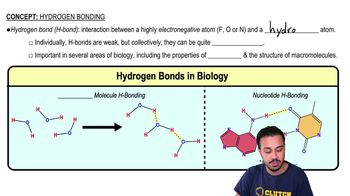
 05:03
05:03