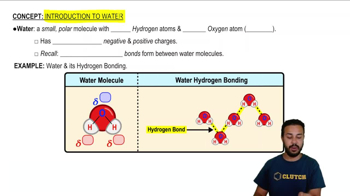
The electrons in water's polar covalent bonds spend more time near oxygen than hydrogen, creating partial negative and positive charges, making the molecule polar.
What allows water molecules to form hydrogen bonds?
Water's polarity causes uneven charge distribution, enabling weak attractions called hydrogen bonds between molecules.
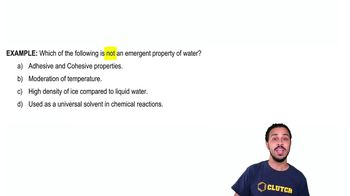
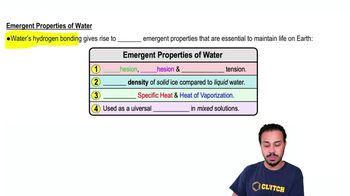
Name four properties of water that facilitate life.
Cohesive behavior, ability to moderate temperature, expansion upon freezing, and versatility as a solvent.
What is cohesion in water?
Hydrogen bonds hold water molecules together, creating cohesion, which results in high surface tension.
How does adhesion help plants transport water?
Adhesion is attraction between water and plant cell walls, helping water move upward against gravity.
Define thermal energy and temperature in the context of water.
Thermal energy is kinetic energy from random molecular motion; temperature is the average kinetic energy of molecules.
What is a calorie in terms of water heating?
A calorie is the heat needed to raise 1 g of water by 1°C or released when 1 g cools by 1°C.
What is specific heat and water's specific heat value?
Specific heat is heat needed to change 1 g of substance by 1°C; water's is 4.184 J/g°C, meaning it resists temperature change.
How do hydrogen bonds affect water's specific heat?
Heat is absorbed when hydrogen bonds break and released when they form, giving water a high specific heat.
What is evaporative cooling?
When water evaporates, molecules with highest kinetic energy leave, cooling the surface left behind.
Why does ice float on liquid water?
Ice is less dense because hydrogen bonds form a crystalline lattice that spaces molecules farther apart.
What is a solution, solvent, and solute?
A solution is a homogeneous liquid mixture; solvent dissolves the solute, which is the dissolved substance.
Why is water a versatile solvent?
Water's polarity allows it to surround ions and polar molecules, forming hydration shells and dissolving many substances.
Define hydrophilic and hydrophobic substances.
Hydrophilic substances have affinity for water; hydrophobic substances repel water, often nonpolar like oils.
What is molarity (M)?
Molarity is the number of moles of solute per liter of solution.
What happens during water molecule dissociation?
Water molecules split into hydronium ions (H3O+) and hydroxide ions (OH-), maintaining dynamic equilibrium.
How do acids and bases affect proton concentration?
 Indietro
 01:54