What type of bond shares electrons equally between atoms?
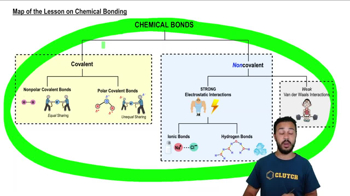
Nonpolar covalent bonds share electrons equally, such as in C-C or C-H bonds.
What makes a covalent bond polar?
A polar covalent bond shares electrons unequally due to differences in electronegativity, e.g., O-H or C-O bonds.
Why is water (H2O) a polar molecule?
Water is polar because it has polar covalent bonds and an asymmetrical (bent) shape, causing partial charges.
What is electronegativity and how does it relate to water's polarity?
Electronegativity is an atom's ability to attract electrons; oxygen (3.44) is more electronegative than hydrogen (2.1), pulling electrons closer and creating polarity.
What are the partial charges on a water molecule?
Oxygen has a partial negative charge (δ-) and hydrogens have partial positive charges (δ+) due to unequal electron sharing.
What is the molecular geometry of water?
Water has a bent molecular shape with a bond angle of about 104.4°, due to two lone pairs on oxygen.
How do hydrogen bonds form between water molecules?
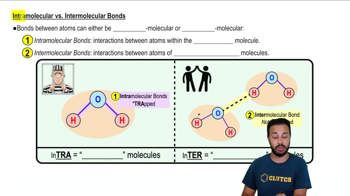
Hydrogen bonds form between the partially positive hydrogen of one water molecule and the partially negative oxygen of another.
Are hydrogen bonds covalent bonds? Explain.
No, hydrogen bonds are noncovalent interactions involving attraction between partial charges, not electron sharing.
Why are hydrogen bonds important in biology?
They stabilize structures like DNA double helix and protein folding, and give water its unique properties.
What are emergent properties of water due to hydrogen bonding?
Properties include cohesion, adhesion, high specific heat, ice floating, and solvent abilities.
What is cohesion and adhesion in water?
Cohesion is water molecules sticking to each other; adhesion is water molecules sticking to other polar surfaces.
How does water moderate temperature changes?
Water's high specific heat means it absorbs/releases heat slowly, stabilizing temperatures.
Why does ice float on liquid water?
Ice forms a less dense crystal lattice due to stable hydrogen bonds, making it float.
What does hydrophilic mean?
Hydrophilic molecules are polar and interact well with water, dissolving easily.
What does hydrophobic mean?
Hydrophobic molecules are nonpolar and do not dissolve in water, avoiding hydrogen bonding.
How does salt (NaCl) dissolve in water?
Water molecules surround ions; oxygen attracts Na+ and hydrogen attracts Cl-, separating the ions.
What is pH a measure of?
pH measures the concentration of hydrogen ions [H+] in a solution.
What is the pH of pure water and why?
Pure water has a neutral pH of 7 because [H+] equals [OH-].
How does the pH scale work?
The pH scale is logarithmic; each unit change represents a tenfold change in [H+].
What is the role of buffers in biological systems?
Buffers resist changes in pH by accepting or donating H+ ions to maintain stable conditions.
 Indietro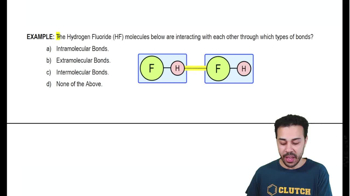
 1:59
1:59