Skip to main content
General Biology
Il mio corso
Impara
Preparazione agli esami
AI Tutor
Guide di studio
Soluzioni per libri di testo
Flashcard
Esplora
Prova l'app
Il mio corso
Impara
Preparazione agli esami
AI Tutor
Guide di studio
Soluzioni per libri di testo
Flashcard
Esplora
Prova l'app
Indietro
Water and Molecular Bonds in General Biology
Puoi toccare per girare la carta.
What type of bond shares electrons equally between atoms?
Puoi toccare per girare la carta.
👆
What type of bond shares electrons equally between atoms?
Nonpolar covalent bonds
share electrons equally, such as in C-C or C-H bonds.
Avanzamenti del tracciato
I pulsanti di controllo sono stati cambiati in modalità "navigazione".
1/20
Video consigliati
1:59
Introduction to Chemical Bonding Example 1
10085
views
187
rank
03:53
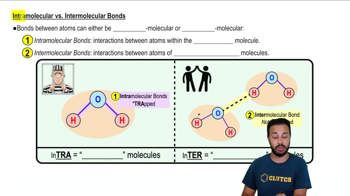
Intramolecular vs. Intermolecular Bonds
24177
views
480
rank
1
comments
02:42
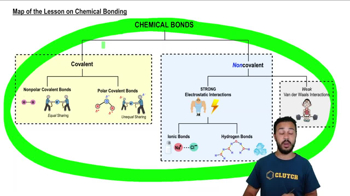
Map of the Lesson on Chemical Bonding
23187
views
326
rank
Termini in questo insieme (20)
Nascondere definizioni
What type of bond shares electrons equally between atoms?
Nonpolar covalent bonds
share electrons equally, such as in C-C or C-H bonds.
What makes a covalent bond polar?
A
polar covalent bond
shares electrons unequally due to differences in electronegativity, e.g., O-H bonds.
Why is water (H2O) a polar molecule?
Water is polar because oxygen is more electronegative than hydrogen, causing electrons to spend more time near oxygen, creating partial charges.
What is the molecular shape of water and its bond angle?
Water has a
bent molecular shape
with a bond angle of approximately \(104.4^\circ\) due to lone pairs on oxygen.
How do electronegativity values relate to bond polarity?
Greater differences in electronegativity between atoms lead to more
polar bonds
; for example, O (3.44) and H (2.1) form polar bonds.
What is a hydrogen bond?
A
hydrogen bond
is a weak attraction between a partially positive hydrogen atom and a partially negative atom like oxygen or nitrogen.
Are electrons shared in hydrogen bonds?
No, hydrogen bonds are
noncovalent
and do not involve sharing electrons.
What role do hydrogen bonds play in water's properties?
Hydrogen bonds cause water's unique properties like cohesion, high specific heat, ice floating, and solvent abilities.
What is the difference between hydrophilic and hydrophobic molecules?
Hydrophilic molecules
are polar and interact well with water;
hydrophobic molecules
are nonpolar and do not dissolve in water.
How does water dissolve ionic compounds like salt (NaCl)?
Water molecules surround ions, with oxygen attracting cations (Na+) and hydrogen attracting anions (Cl-), forming a hydration shell.
What is the significance of water's polarity for biological molecules?
Water's polarity allows it to dissolve polar molecules and ions, facilitating biochemical reactions and transport in cells.
How does the shape of methane (CH4) compare to water (H2O)?
Methane is
tetrahedral and nonpolar
, while water is
bent and polar
due to lone pairs on oxygen.
What is the relationship between molecular symmetry and polarity?
Symmetrical molecules like CO2 are often
nonpolar
, while asymmetrical molecules like H2O are
polar
.
What is the effect of hydrogen bonding on DNA structure?
Hydrogen bonds hold complementary base pairs together, stabilizing the DNA double helix.
What is the electronegativity of oxygen and hydrogen?
Oxygen has an electronegativity of
3.44
, and hydrogen has
2.1
.
What is the difference between polar covalent and ionic bonds?
Polar covalent bonds share electrons unequally, while ionic bonds involve complete transfer of electrons between atoms.
How does water's high specific heat benefit living organisms?
Water absorbs and stores large amounts of heat with minimal temperature change, helping organisms regulate temperature.
Why does ice float on liquid water?
Ice is less dense because stable hydrogen bonds form a crystal lattice that spaces molecules further apart.
What is the role of lone pairs on oxygen in water's shape?
Lone pairs repel bonded hydrogen atoms, causing the bent shape and polarity of water.
How do polar covalent bonds contribute to partial charges in water?
Electrons spend more time near oxygen, giving it a partial negative charge (δ-), and hydrogens partial positive charges (δ+).
 IndietroIndietro
 1:59
1:59