Skip to main content
General Biology
Il mio corso
Impara
Preparazione agli esami
AI Tutor
Guide di studio
Soluzioni per libri di testo
Flashcard
Esplora
Prova l'app
Il mio corso
Impara
Preparazione agli esami
AI Tutor
Guide di studio
Soluzioni per libri di testo
Flashcard
Esplora
Prova l'app
Indietro
Water and Molecular Bonds in General Biology
Puoi toccare per girare la carta.
What type of bond shares electrons equally between atoms?
Puoi toccare per girare la carta.
👆
What type of bond shares electrons equally between atoms?
Nonpolar covalent bonds
share electrons equally, such as in C-C or C-H bonds.
Avanzamenti del tracciato
I pulsanti di controllo sono stati cambiati in modalità "navigazione".
1/20
Video consigliati
1:59
Introduction to Chemical Bonding Example 1
10145
views
188
rank
03:53
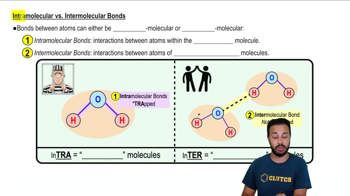
Intramolecular vs. Intermolecular Bonds
24294
views
481
rank
1
comments
02:42
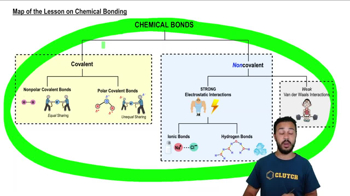
Map of the Lesson on Chemical Bonding
23298
views
328
rank
Termini in questo insieme (20)
Nascondere definizioni
What type of bond shares electrons equally between atoms?
Nonpolar covalent bonds
share electrons equally, such as in C-C or C-H bonds.
What makes a covalent bond polar?
Polar covalent bonds
share electrons unequally due to differences in electronegativity, e.g., O-H or C-O bonds.
Why is water (H2O) a polar molecule?
Water is polar because oxygen is more electronegative than hydrogen, causing electrons to spend more time near oxygen, creating partial charges.
What is the shape and bond angle of a water molecule?
Water has a
bent molecular shape
with a bond angle of about \(104.4^\circ\) due to lone pairs on oxygen.
What is electronegativity and how does it relate to bond polarity?
Electronegativity is an atom's ability to attract electrons; differences cause unequal sharing, leading to polar bonds.
What are hydrogen bonds?
Hydrogen bonds are weak attractions between a partially positive hydrogen and a partially negative atom like oxygen or nitrogen.
How strong are hydrogen bonds compared to covalent bonds?
Hydrogen bonds are about 5% as strong as covalent bonds but are important due to their cumulative effects.
What emergent properties of water arise from hydrogen bonding?
Properties include cohesion, adhesion, high specific heat, ice floating, and water as a good solvent for polar molecules.
Why does ice float on water?
Ice is less dense because stable hydrogen bonds form a crystal lattice that spaces molecules apart.
What does hydrophilic mean?
Hydrophilic molecules are polar and interact well with water, dissolving easily.
What does hydrophobic mean?
Hydrophobic molecules are nonpolar, do not form hydrogen bonds, and do not dissolve in water.
How does water dissolve ionic compounds like salt (NaCl)?
Water molecules surround ions, with oxygen attracting Na+ and hydrogen attracting Cl-, separating the ions.
What is the pH scale a measure of?
pH measures the concentration of hydrogen ions \([H^+]\) in a solution on a logarithmic scale.
What is the pH of pure water and why?
Pure water has a neutral pH of 7 because \([H^+] = [OH^-]\).
How does a change of one pH unit affect hydrogen ion concentration?
A one-unit change in pH represents a tenfold change in \([H^+]\) concentration.
What is the role of buffers in biological systems?
Buffers resist changes in pH by accepting or donating hydrogen ions to maintain stable conditions.
What is the difference between polar and nonpolar molecules in terms of symmetry?
Polar molecules are asymmetrical with uneven charge distribution; nonpolar molecules are symmetrical with even charge distribution.
How do hydrogen bonds contribute to DNA structure?
Hydrogen bonds hold complementary base pairs together, stabilizing the DNA double helix.
What is the difference between polar covalent bonds and hydrogen bonds?
Polar covalent bonds share electrons unequally within a molecule; hydrogen bonds are weak attractions between molecules.
Why is the shape of a molecule important for its polarity?
Molecular shape determines if polar bonds create an overall dipole; asymmetry leads to polarity.
 IndietroIndietro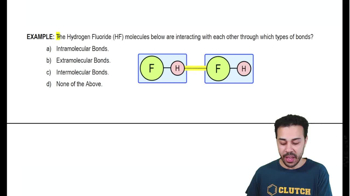
 1:59
1:59