

Ch. 56 - Conservation Biology and Global Change
Campbell - Campbell Biology 11th Edition
Urry11th EditionCampbell BiologyISBN: 9789357423311Non è quello che usi tu?Cambia libro di testo
Capitolo 56, Problema 2

The main cause of the increase in the amount of CO₂ in Earth's atmosphere over the past 150 years is
a. Increased worldwide primary production
b. Increased worldwide standing crop
c. An increase in the amount of infrared radiation absorbed by the atmosphere
d. The burning of larger amounts of wood and fossil fuels

Guida verificata passo dopo passo
1
Understand the context of the problem: The question is asking about the primary cause of the increase in CO₂ levels in Earth's atmosphere over the past 150 years. This requires knowledge of human activities and their impact on the carbon cycle.
Review the carbon cycle: CO₂ is naturally cycled through processes like photosynthesis, respiration, and decomposition. However, human activities can disrupt this balance, leading to an increase in atmospheric CO₂ levels.
Analyze the options provided: Option (a) refers to increased primary production, which is the process by which plants convert CO₂ into organic matter through photosynthesis. This would decrease CO₂ levels, not increase them. Option (b) refers to standing crop, which is the biomass of plants at a given time. This also does not directly increase CO₂ levels. Option (c) mentions infrared radiation absorption, which is a consequence of increased CO₂ but not the cause.
Focus on option (d): The burning of wood and fossil fuels releases stored carbon into the atmosphere as CO₂. Fossil fuels like coal, oil, and natural gas contain carbon that has been sequestered underground for millions of years. When burned, this carbon is released, significantly increasing atmospheric CO₂ levels.
Conclude the reasoning: Based on the analysis, the primary cause of the increase in CO₂ levels over the past 150 years is the burning of larger amounts of wood and fossil fuels, as this directly adds CO₂ to the atmosphere.

Risposta video verificata per un problema simile:

Questa soluzione video è stata consigliata dai nostri tutor come utile per risolvere questo problema.
Durata del video:
1m

Concetti chiave

Ecco i concetti essenziali che devi comprendere per rispondere correttamente alla domanda.

Carbon Dioxide Emissions

Carbon dioxide (CO₂) emissions primarily result from human activities, particularly the burning of fossil fuels and biomass. These emissions contribute significantly to the greenhouse effect, leading to global warming. Understanding the sources and impacts of CO₂ is crucial for addressing climate change.
Video consigliato:
04:19
Carbon

Fossil Fuels

Fossil fuels, including coal, oil, and natural gas, are carbon-rich energy sources formed from ancient organic matter. Their combustion for energy releases large amounts of CO₂ into the atmosphere, making them a major contributor to increased atmospheric CO₂ levels. The reliance on fossil fuels for energy is a key factor in climate change.
Video consigliato:

Greenhouse Effect

The greenhouse effect is a natural process where certain gases in the Earth's atmosphere trap heat, keeping the planet warm enough to support life. However, human activities, particularly the burning of fossil fuels, have intensified this effect by increasing the concentration of greenhouse gases like CO₂, leading to global warming and climate change.
Video consigliato:
04:52
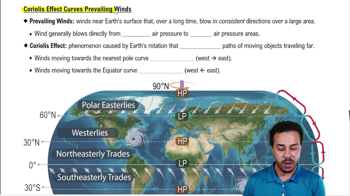
Coriolis Effect Curves Prevailing Winds
Pratica correlata
Domanda del libro di testo

Which of these is a consequence of biological magnification?

a. Toxic chemicals in the environment pose greater risk to top-level predators than to primary consumers.

b. Populations of top-level predators are generally smaller than populations of primary consumers.

c. The biomass of producers in an ecosystem is generally higher than the biomass of primary consumers.

d. Only a small portion of the energy captured by producers is transferred to consumers.

853
views
Domanda del libro di testo

Which of the following strategies would most rapidly increase the genetic diversity of a population in an extinction vortex?

a. Establish a reserve that protects the population's habitat

b. Introduce new individuals transported from other populations of the same species

c. Sterilize the least fit individuals in the population

d. Control populations of the endangered population's predators and competitors

1236
views
Domanda del libro di testo

What is the single greatest threat to biodiversity?

a. Overharvesting of commercially important species

b. Habitat alteration, fragmentation, and destruction

c. Introduced species that compete with native species

d. Novel pathogens

1253
views
Domanda del libro di testo

One characteristic that distinguishes a population in an extinction vortex from most other populations is that

a. It is a rare, top-level predator

b. Its effective population size is lower than its total population size

c. Its genetic diversity is very low

d. It is not well adapted to edge conditions

917
views
1
comments