Ch. 25 - Phylogenies and the History of Life
Freeman - Biological Science 8th Edition
Freeman8th EditionBiological ScienceISBN: 9780138276263Non è quello che usi tu?Cambia libro di testo
Capitolo 25, Problema 4

Which of the following is an example of homoplasy?
a. Hair in humans and fur in mice
b. Astragalus ankle bones in hippos and deer
c. Hox genes in humans and flies
d. Streamlined bodies in dolphins and ichthyosaurs

Guida verificata passo dopo passo
1
Understand the concept of homoplasy: Homoplasy refers to a trait that is similar in two species due to convergent evolution, not because of shared ancestry.
Analyze option a: Hair in humans and fur in mice are similar traits, but they are due to shared ancestry, not convergent evolution. This is an example of homology, not homoplasy.
Evaluate option b: Astragalus ankle bones in hippos and deer are similar due to shared ancestry, making them homologous structures, not homoplasy.
Consider option c: Hox genes in humans and flies are similar due to shared ancestry and are examples of homology, not homoplasy.
Examine option d: Streamlined bodies in dolphins and ichthyosaurs are similar due to convergent evolution, as both adapted to aquatic environments independently. This is an example of homoplasy.

Risposta video verificata per un problema simile:

Questa soluzione video è stata consigliata dai nostri tutor come utile per risolvere questo problema.
Durata del video:
3m

Concetti chiave

Ecco i concetti essenziali che devi comprendere per rispondere correttamente alla domanda.

Homoplasy

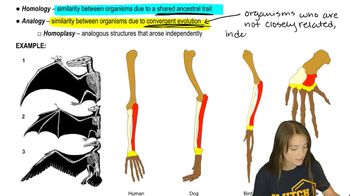
Homoplasy refers to a trait that appears similar in two species but is not derived from a common ancestor. This similarity arises due to convergent evolution, where different species independently evolve similar traits as adaptations to similar environments or ecological niches. An example is the streamlined bodies of dolphins and ichthyosaurs, which evolved independently in response to aquatic life.
Video consigliato:
15:37
Homology and Homoplasy

Convergent Evolution

Convergent evolution is the process where organisms not closely related independently evolve similar traits as a result of having to adapt to similar environments or ecological roles. This leads to the development of analogous structures, which serve similar functions but do not share a common ancestral origin. Streamlined bodies in dolphins and ichthyosaurs are a classic example of convergent evolution.
Video consigliato:
05:22
Convergent and Divergent Evolution

Analogous Structures

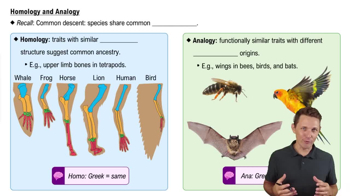
Analogous structures are features in different species that perform a similar function but do not share a common ancestral origin. These structures arise due to convergent evolution, where species adapt to similar environmental challenges. For instance, the wings of bats and birds are analogous, as they serve the same function of flight but evolved independently in these lineages.
Video consigliato:
Percorso guidato
04:35
Homology and Analogy