
Ch. 6 - Lipids, Membranes, and the First Cells
Freeman - Biological Science 8th Edition
Freeman8th EditionBiological ScienceISBN: 9780138276263Non è quello che usi tu?Cambia libro di testo
Capitolo 6, Problema 4

Which of the following groups of amino acid residues would likely be found in the portion that crosses the lipid bilayer?
a. Acidic
b. Basic
c. Polar uncharged
d. Nonpolar

Guida verificata passo dopo passo
1
Understand that the lipid bilayer is a hydrophobic environment, meaning it repels water and is composed mainly of nonpolar molecules.
Recognize that amino acids with nonpolar side chains are more likely to be found in the hydrophobic core of the lipid bilayer because they do not interact with water.
Identify the nonpolar amino acids from the image: Glycine (Gly), Alanine (Ala), Valine (Val), Leucine (Leu), Isoleucine (Ile), Methionine (Met), Cysteine (Cys), Phenylalanine (Phe), Tryptophan (Trp), and Proline (Pro).
Consider that polar, acidic, and basic amino acids are more likely to be found on the exterior of the protein or in aqueous environments because they can form hydrogen bonds or ionic interactions with water.
Conclude that the group of amino acid residues most likely to be found in the portion that crosses the lipid bilayer is the nonpolar group.

Risposta video verificata per un problema simile:

Questa soluzione video è stata consigliata dai nostri tutor come utile per risolvere questo problema.
Durata del video:
3m

Concetti chiave

Ecco i concetti essenziali che devi comprendere per rispondere correttamente alla domanda.

Lipid Bilayer Structure

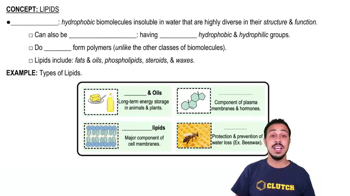
The lipid bilayer is a fundamental component of cell membranes, composed of two layers of phospholipids. The hydrophobic (water-repelling) tails face inward, while the hydrophilic (water-attracting) heads face outward. This arrangement creates a barrier that separates the interior of the cell from the external environment, influencing which molecules can pass through.
Video consigliato:
04:19
Lipids

Amino Acid Properties

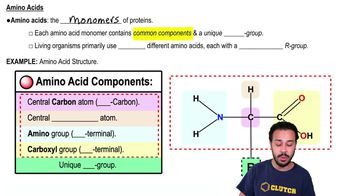
Amino acids can be classified based on their side chains (R groups) into categories such as polar, nonpolar, acidic, and basic. Nonpolar amino acids have hydrophobic side chains that do not interact favorably with water, making them more likely to be found in the lipid bilayer, while polar and charged amino acids tend to be hydrophilic and interact with the aqueous environment.
Video consigliato:
04:37
Amino Acids

Transmembrane Proteins

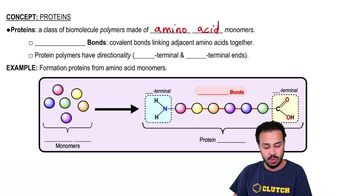
Transmembrane proteins span the lipid bilayer and often contain regions that interact with both the hydrophobic core of the membrane and the aqueous environments on either side. The portions of these proteins that cross the bilayer typically consist of nonpolar amino acids, allowing them to stabilize within the hydrophobic environment of the membrane.
Video consigliato:
02:50
Proteins
Pratica correlata
Domanda del libro di testo

How do the phospholipids in archaea differ from those in other cells?

a. They have tails made of unsaturated fatty acids instead of saturated fatty acids.

b. They do not contain hydrocarbon chains.

c. They have isoprenoid tails instead of fatty acid tails.

d. They have two hydrocarbon chains instead of three hydrocarbon chains.

2473
views
Domanda del libro di testo

Draw and label the plasma membrane of a cell that is placed in a solution with concentrations of calcium ions and lactose that are greater than those on the inside of the cell. Use arrows to show the relevant gradients and the activity of the following membrane proteins:

(1) A pump that exports protons

(2) A calcium channel

(3) A lactose carrier

3011
views
Domanda del libro di testo

Cooking oil lipids consist of long, unsaturated hydrocarbon chains. Would you expect these molecules to form membranes spontaneously? Why or why not? Describe, on a molecular level, how you would expect these lipids to behave in water.

2349
views
Domanda del libro di testo

If a solution surrounding a cell is hypertonic relative to the inside of the cell, how will water move?

a. It will move into the cell via osmosis.

b. It will move out of the cell via osmosis.

c. It will not move, because equilibrium exists.

d. It will evaporate from the cell surface more rapidly.

4305
views
Domanda del libro di testo

What two conditions must be present for osmosis to occur? Integral membrane proteins are anchored in lipid bilayers.

2314
views
Domanda del libro di testo

In terms of structure, how do channel proteins differ from carrier proteins?

3052
views