A function f is increasing on an interval I if for any a < b in I, f(a) < f(b).
Decreasing Function
A function f is decreasing on an interval I if for any a < b in I, f(a) > f(b).
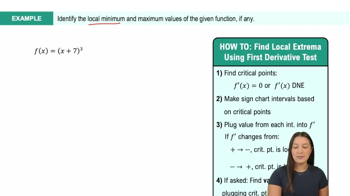
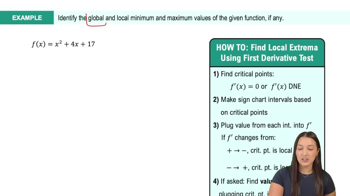
First Derivative Test for Relative Extrema
If f' changes from negative to positive at c, f has a relative minimum at c. If f' changes from positive to negative at c, f has a relative maximum at c. If f' does not change sign at c, no relative extremum exists at c.
Critical Value
A number c in the domain of f where f'(c) = 0 or f'(c) does not exist. The point (c, f(c)) is a critical point.
Concave Up
A function f is concave up on interval I if f''(x) > 0 for all x in I.
Concave Down
A function f is concave down on interval I if f''(x) < 0 for all x in I.
Second Derivative Test for Relative Extrema
If f'(c) = 0 and f''(c) > 0, f has a relative minimum at c. If f''(c) < 0, f has a relative maximum at c. If f''(c) = 0, use the First Derivative Test.
Point of Inflection
A point where f''(x) = 0 or f''(x) does not exist and the concavity of f changes.
Vertical Asymptote
The line x = a is a vertical asymptote if f(x) approaches ±∞ as x approaches a.
Horizontal Asymptote
The line y = b is a horizontal asymptote if f(x) approaches b as x approaches ±∞.
Extreme Value Theorem
A continuous function on a closed interval [a, b] attains both an absolute maximum and an absolute minimum.
Optimization Steps
1. Find f'(x). 2. Find critical values in [a, b]. 3. Evaluate f(x) at critical values and endpoints. 4. Largest value is absolute maximum; smallest is absolute minimum.
Marginal Cost
The derivative of the total cost function, representing the approximate cost of producing one more unit.
Marginal Revenue
The derivative of the total revenue function, representing the approximate revenue from selling one more unit.
Differential
For y = f(x), the differential dy = f'(x) dx approximates the change in y for a small change dx in x.
Linearization
The linear approximation of f(x) at x = a is L(x) = f(a) + f'(a)(x - a).
Elasticity of Demand
E(p) = -p D'(p) / D(p), measuring responsiveness of quantity demanded to price changes.
Interpretation of Elasticity
If E(p) < 1, demand is inelastic; if E(p) > 1, demand is elastic; if E(p) = 1, revenue is maximized (unit elasticity).
Implicit Differentiation
Differentiate both sides of an equation with respect to x, treating y as a function of x.
Logarithmic Differentiation
Take the natural logarithm of both sides before differentiating to simplify derivatives of complicated functions.
Related Rates Method
1. Write an equation relating variables. 2. Differentiate with respect to time. 3. Substitute known values and solve for desired rate.
 Indietro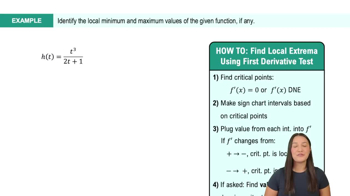
 11:22
11:22