Skip to main content
Calculus
Il mio corso
Impara
Preparazione agli esami
AI Tutor
Guide di studio
Soluzioni per libri di testo
Flashcard
Esplora
Prova l'app
Il mio corso
Impara
Preparazione agli esami
AI Tutor
Guide di studio
Soluzioni per libri di testo
Flashcard
Esplora
Prova l'app
Indietro
Basic Derivatives of Trigonometric Functions
Puoi toccare per girare la carta.
Derivative of \(\sin x\)
Puoi toccare per girare la carta.
👆
Derivative of \(\sin x\)
The derivative of \(\sin x\) is \(\cos x\).
Avanzamenti del tracciato
I pulsanti di controllo sono stati cambiati in modalità "navigazione".
1/18
Video consigliati
03:53
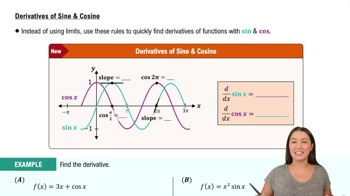
Derivatives of Sine & Cosine
2850
views
61
rank
01:32
Derivatives of Other Trig Functions Example 1
1517
views
37
rank
03:51
Higher Order Derivatives of Sine & Cosine
2008
views
37
rank
Termini in questo insieme (18)
Nascondere definizioni
Derivative of \(\sin x\)
The derivative of \(\sin x\) is \(\cos x\).
Derivative of \(\cos x\)
The derivative of \(\cos x\) is \(-\sin x\).
Derivative of \(\tan x\)
The derivative of \(\tan x\) is \(\sec^2 x\).
Derivative of \(\cot x\)
The derivative of \(\cot x\) is \(-\csc^2 x\).
Derivative of \(\sec x\)
The derivative of \(\sec x\) is \(\sec x \tan x\).
Derivative of \(\csc x\)
The derivative of \(\csc x\) is \(-\csc x \cot x\).
What rule is commonly used with derivatives of trig functions?
The
chain rule
is often used when trig functions have composite arguments.
Derivative of \(\sin(kx)\) where k is a constant
The derivative is \(k \cos(kx)\).
Derivative of \(\cos(kx)\) where k is a constant
The derivative is \(-k \sin(kx)\).
Why is the derivative of \(\tan x\) positive?
Because \(\tan x = \frac{\sin x}{\cos x}\) and its derivative simplifies to \(\sec^2 x\), which is always positive where defined.
Derivative of \(\sin^{-1} x\) (inverse sine)
The derivative is \(\frac{1}{\sqrt{1 - x^2}}\).
Derivative of \(\cos^{-1} x\) (inverse cosine)
The derivative is \(-\frac{1}{\sqrt{1 - x^2}}\).
Derivative of \(\tan^{-1} x\) (inverse tangent)
The derivative is \(\frac{1}{1 + x^2}\).
How to find the derivative of a product involving trig functions?
Use the
product rule
: derivative of first times second plus first times derivative of second.
How to find the derivative of a quotient involving trig functions?
Use the
quotient rule
: (derivative of numerator times denominator minus numerator times derivative of denominator) over denominator squared.
What is the derivative of \(\sec^2 x\)?
The derivative is \(2 \sec^2 x \tan x\).
What is the derivative of \(\csc x \cot x\)?
Use the product rule: derivative of \(\csc x\) times \(\cot x\) plus \(\csc x\) times derivative of \(\cot x\).
What is the significance of the derivatives of trig functions in calculus?
They are essential for solving problems involving rates of change, motion, and oscillations.
 IndietroIndietro
 03:53