Skip to main content
Calculus
Il mio corso
Impara
Preparazione agli esami
AI Tutor
Guide di studio
Soluzioni per libri di testo
Flashcard
Esplora
Prova l'app
Il mio corso
Impara
Preparazione agli esami
AI Tutor
Guide di studio
Soluzioni per libri di testo
Flashcard
Esplora
Prova l'app
Indietro
Calculus: Limits and Derivatives of Trigonometric Functions
Puoi toccare per girare la carta.
What is the limit of \(\frac{\sin x}{x}\) as \(x \to 0\)?
Puoi toccare per girare la carta.
👆
What is the limit of \(\frac{\sin x}{x}\) as \(x \to 0\)?
The limit is \(1\).
Avanzamenti del tracciato
I pulsanti di controllo sono stati cambiati in modalità "navigazione".
1/20
Video consigliati
03:53
Derivatives of Sine & Cosine
2501
views
56
rank
01:32
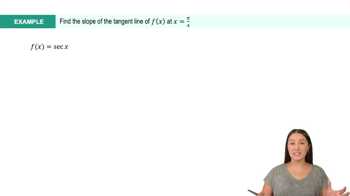
Derivatives of Other Trig Functions Example 1
1343
views
36
rank
03:51
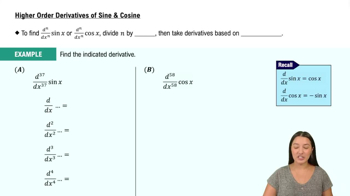
Higher Order Derivatives of Sine & Cosine
1765
views
37
rank
Termini in questo insieme (20)
Nascondere definizioni
What is the limit of \(\frac{\sin x}{x}\) as \(x \to 0\)?
The limit is \(1\).
What is the limit of \(\frac{\cos x - 1}{x}\) as \(x \to 0\)?
The limit is \(0\).
State the limit definition of the derivative for \(\sin x\).
The derivative is defined as \(\lim_{h \to 0} \frac{\sin(x+h) - \sin x}{h}\).
What is the derivative of \(\sin x\)?
The derivative is \(\cos x\).
What is the derivative of \(\cos x\)?
The derivative is \(-\sin x\).
State the angle addition formula for sine.
\(\sin(A+B) = \sin A \cos B + \cos A \sin B\).
State the angle addition formula for cosine.
\(\cos(A+B) = \cos A \cos B - \sin A \sin B\).
What is the derivative of \(\tan x\)?
The derivative is \(\sec^2 x\).
What is the derivative of \(\sec x\)?
The derivative is \(\sec x \tan x\).
What is the derivative of \(\cot x\)?
The derivative is \(-\csc^2 x\).
What is the derivative of \(\csc x\)?
The derivative is \(-\csc x \cot x\).
How do you apply the quotient rule to find the derivative of \(\tan x = \frac{\sin x}{\cos x}\)?
Use \(\frac{d}{dx} \left( \frac{N}{D} \right) = \frac{N' D - N D'}{D^2}\) with \(N=\sin x\) and \(D=\cos x\).
What is the limit of \(\frac{\sin 3x}{3x}\) as \(x \to 0\)?
The limit is \(1\).
What is the limit of \(\frac{\sin 2x}{x}\) as \(x \to 0\)?
The limit is \(2\).
What is the derivative of \(\sin(At+B)\) using the chain rule?
The derivative is \(A \cos(At+B)\).
What is the derivative of \(\cos(At+B)\) using the chain rule?
The derivative is \(-A \sin(At+B)\).
What is the derivative of \(\sec^2 x\)?
The derivative is \(2 \sec^2 x \tan x\) by chain rule.
What is the derivative of \(\log(2x)\) at \(x=0\)?
The derivative is undefined at \(x=0\) because \(\log(0)\) is undefined.
What is the derivative of \(\tan x\) using the quotient rule?
Using quotient rule on \(\frac{\sin x}{\cos x}\), derivative is \(\sec^2 x\).
What is the derivative of \(\sin x \cos x\) using the product rule?
The derivative is \(\cos^2 x - \sin^2 x\).
 IndietroIndietro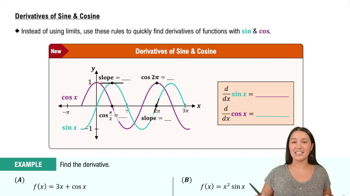
 03:53
03:53