Ch. 10 - Sequences and Infinite Series
Briggs - Calculus: Early Transcendentals 3rd Edition
Briggs3rd EditionCalculus: Early TranscendentalsISBN: 9780136847243Non è quello che usi tu?Cambia libro di testo
Capitolo 10, Problema 10.3.33

21–42. Geometric series Evaluate each geometric series or state that it diverges.  


33.∑ (k = 4 to ∞) 1 / 5ᵏ

Guida verificata passo dopo passo
1
Identify the first term \( a \) of the geometric series by substituting the starting index \( k = 4 \) into the term \( \frac{1}{5^k} \). So, \( a = \frac{1}{5^4} \).
Determine the common ratio \( r \) of the geometric series. Since the terms are of the form \( \frac{1}{5^k} \), the ratio between consecutive terms is \( \frac{1}{5} \).
Check the convergence of the series by verifying if the absolute value of the common ratio \( |r| < 1 \). If this condition holds, the series converges; otherwise, it diverges.
If the series converges, use the formula for the sum of an infinite geometric series starting at \( k = 0 \): \[ S = \frac{a}{1 - r} \]. Since our series starts at \( k = 4 \), \( a \) is already the first term at \( k=4 \).
Substitute the values of \( a \) and \( r \) into the sum formula to express the sum of the series. This will give the sum in terms of powers of 5 without calculating the final numeric value.

Risposta video verificata per un problema simile:

Questa soluzione video è stata consigliata dai nostri tutor come utile per risolvere questo problema.
Durata del video:
4m

Concetti chiave

Ecco i concetti essenziali che devi comprendere per rispondere correttamente alla domanda.

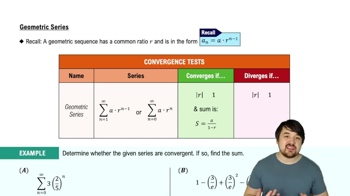
Geometric Series

A geometric series is a sum of terms where each term is found by multiplying the previous term by a constant ratio. It has the form ∑ ar^k, where a is the first term and r is the common ratio. Understanding this structure helps in identifying and evaluating the series.
Video consigliato:
Percorso guidato
06:00
Geometric Series

Convergence of Infinite Geometric Series

An infinite geometric series converges if the absolute value of the common ratio |r| is less than 1. When it converges, the sum can be calculated using the formula S = a / (1 - r). If |r| ≥ 1, the series diverges and does not have a finite sum.
Video consigliato:
Percorso guidato
06:52
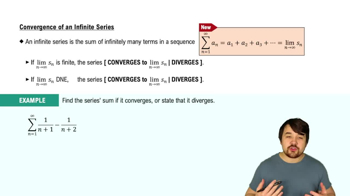
Convergence of an Infinite Series

Index Shift in Series Summation

When a series starts at an index other than zero or one, it may be necessary to adjust the formula for the sum by rewriting the series with a shifted index. This helps in correctly identifying the first term a and applying the geometric series sum formula.
Video consigliato:
Percorso guidato
06:00
Geometric Series
Pratica correlata
Domanda del libro di testo

13–20. Explicit formulas Write the first four terms of the sequence { aₙ }∞ₙ₌₁. 

aₙ = 1/10ⁿ

76
views

Domanda del libro di testo

32–49. Choose your test Use the test of your choice to determine whether the following series converge absolutely, converge conditionally, or diverge.

∑ (from k = 1 to ∞) k¹⁰⁰ / (k + 1)!

47
views
Domanda del libro di testo

9–36. Comparison tests Use the Comparison Test or the Limit Comparison Test to determine whether the following series converge.


∑ (k = 1 to ∞) (2 + (−1)ᵏ) / k²

36
views
Domanda del libro di testo

16–17. {Use of Tech} Periodic savings

Suppose you deposit m dollars at the beginning of every month in a savings account that earns a monthly interest rate of r, which is the annual interest rate divided by 12 (for example, if the annual interest rate is 2.4%, r = 0.024/12 = 0.002). For an initial investment of m dollars, the amount of money in your account at the beginning of the second month is the sum of your second deposit and your initial deposit plus interest, or m + m(1 + r). Continuing in this fashion, it can be shown that the amount of money in your account after n months is


Aₙ = m + m(1 + r) + ⋯ + m(1 + r)ⁿ⁻¹.


Use geometric sums to determine the amount of money in your savings account after 5 years (60 months) using the given monthly deposit and interest rate.


17. Monthly deposits of \$250 at a monthly interest rate of 0.2%

67
views
Domanda del libro di testo

39–44. {Use of Tech} Estimating infinite series Estimate the value of the following convergent series with an absolute error less than 10⁻³.


∑ (k = 1 to ∞) (−1)ᵏ / k⁵

39
views
Domanda del libro di testo

17–22. Integral Test Use the Integral Test to determine whether the following series converge after showing that the conditions of the Integral Test are satisfied.

∑ (k = 1 to ∞) 1 / (∛(5k + 3))

85
views