The terms of a sequence of partial sums are defined by Sₙ = ∑ⁿₖ₌₁ k² , for n=1, 2, 3, .....Evaluate the first four terms of the sequence.
Ch. 10 - Sequences and Infinite Series
Briggs3rd EditionCalculus: Early TranscendentalsISBN: 9780136847243Non è quello che usi tu?Cambia libro di testo
Capitolo 10, Problema 10.2.55
55–70. More sequences
Find the limit of the following sequences or determine that the sequence diverges.
{(−1)ⁿ / 2ⁿ}
Guida verificata passo dopo passo1
Identify the general term of the sequence, which is given by \(a_n = \frac{(-1)^n}{2^n}\).
Recall that \((-1)^n\) alternates between \(1\) and \(-1\) as \(n\) increases, causing the numerator to alternate signs.
Note that the denominator \$2^n$ grows exponentially as $n$ increases, becoming very large.
Consider the behavior of the absolute value of the terms: \(\left|a_n\right| = \frac{1}{2^n}\), which approaches \(0\) as \(n \to \infty\).
Since the numerator only changes sign but the magnitude approaches zero, conclude that the sequence converges to \(0\).

Risposta video verificata per un problema simile:
Questa soluzione video è stata consigliata dai nostri tutor come utile per risolvere questo problema.
Durata del video:
1mConcetti chiave
Ecco i concetti essenziali che devi comprendere per rispondere correttamente alla domanda.
Sequence and Limit
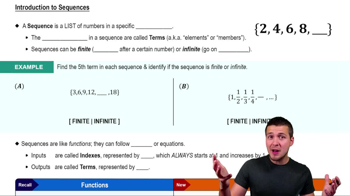
A sequence is an ordered list of numbers defined by a specific formula. The limit of a sequence is the value that the terms approach as the index goes to infinity. Understanding how to find limits helps determine if a sequence converges to a finite value or diverges.
Video consigliato:
Introduction to Sequences
Behavior of Exponential Terms
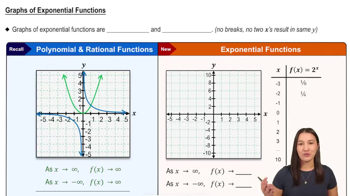
Exponential terms like 2ⁿ grow rapidly as n increases. When in the denominator, such terms cause the overall fraction to approach zero. Recognizing this behavior is key to evaluating limits involving exponential expressions.
Video consigliato:
Graphs of Exponential Functions
Alternating Sequences
An alternating sequence changes sign with each term, often represented by (−1)ⁿ. While the sign alternates, the magnitude may approach zero or another value. Understanding this helps analyze whether the sequence converges or oscillates without settling.
Video consigliato:
Introduction to Sequences
Pratica correlata
Domanda del libro di testo
72
views
Domanda del libro di testo
40–62. Choose your test Use the test of your choice to determine whether the following series converge.
∑ (k = 2 to ∞) 1 / (klnk)
55
views
Domanda del libro di testo
9–15. Geometric sums Evaluate each geometric sum.
∑ k = 0 to 83ᵏ
41
views
Domanda del libro di testo
13–52. Limits of sequences
Find the limit of the following sequences or determine that the sequence diverges.
{(3n³ − 1)⁄(2n³ + 1)}
34
views
Domanda del libro di testo
11–86. Applying convergence tests Determine whether the following series converge. Justify your answers.
∑ (from k = 1 to ∞) (−1)ᵏ × k / (k³ + 1)
55
views
Domanda del libro di testo
32–49. Choose your test Use the test of your choice to determine whether the following series converge absolutely, converge conditionally, or diverge.
∑ (from k = 1 to ∞) (√k / k − 1)²ᵏ
41
views