
Ch. 10 - Sequences and Infinite Series
Briggs - Calculus: Early Transcendentals 3rd Edition
Briggs3rd EditionCalculus: Early TranscendentalsISBN: 9780136847243Non è quello che usi tu?Cambia libro di testo
Capitolo 10, Problema 10.1.75c

72–75. {Use of Tech} Practical sequences
Consider the following situations that generate a sequence


c.Find a recurrence relation that generates the sequence.


Drug elimination
Jack took a 200-mg dose of a pain killer at midnight. Every hour, 5% of the drug is washed out of his bloodstream. Let dₙ be the amount of drug in Jack’s blood n hours after the drug was taken, where d₀ = 200mg.

Guida verificata passo dopo passo
1
Identify the initial condition given: the amount of drug at time zero is \(d_0 = 200\) mg.
Understand the process: every hour, 5% of the drug is eliminated, meaning 95% remains after each hour.
Express the amount of drug remaining after one hour in terms of the previous amount: \(d_1 = 0.95 \times d_0\).
Generalize this relationship to a recurrence relation for any hour \(n\): \(d_n = 0.95 \times d_{n-1}\) for \(n \geq 1\).
Summarize the recurrence relation with the initial condition: \(d_0 = 200\) and \(d_n = 0.95 \times d_{n-1}\).

Risposta video verificata per un problema simile:

Questa soluzione video è stata consigliata dai nostri tutor come utile per risolvere questo problema.
Durata del video:
3m

Concetti chiave

Ecco i concetti essenziali che devi comprendere per rispondere correttamente alla domanda.

Recurrence Relations

A recurrence relation defines each term of a sequence using one or more previous terms. It provides a way to model processes that evolve step-by-step, such as drug concentration over time. Understanding how to express the current amount based on the previous amount is key to formulating the relation.
Video consigliato:
Percorso guidato
04:16
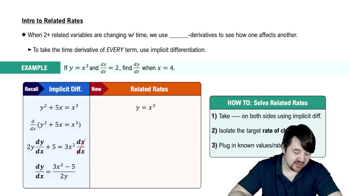
Intro To Related Rates

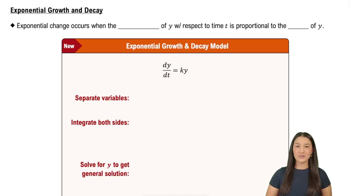
Exponential Decay

Exponential decay describes a quantity that decreases by a fixed percentage over equal time intervals. In this problem, 5% of the drug is eliminated each hour, meaning 95% remains. Recognizing this helps to model the drug amount as a sequence that decreases multiplicatively.
Video consigliato:
09:29
Exponential Growth & Decay

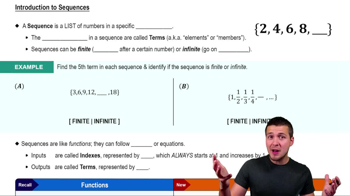
Initial Conditions in Sequences

Initial conditions specify the starting value of a sequence, which is essential for solving recurrence relations. Here, d₀ = 200 mg sets the initial drug amount in the bloodstream, anchoring the sequence and allowing calculation of subsequent terms.
Video consigliato:
8:22
Introduction to Sequences
Pratica correlata
Domanda del libro di testo

{Use of Tech} A savings plan

James begins a savings plan in which he deposits \$100 at the beginning of each month into an account that earns 9% interest annually, or equivalently, 0.75% per month.

To be clear, on the first day of each month, the bank adds 0.75% of the current balance as interest, and then James deposits \$100.


Let Bₙ be the balance in the account after the nᵗʰ payment, where B₀ = \$0.


b.Find a recurrence relation that generates the sequence {Bₙ}.

53
views
Domanda del libro di testo

Explain why or why not Determine whether the following statements are true and give an explanation or counterexample.


c. A series that converges conditionally must converge.

40
views
Domanda del libro di testo

Explain why or why not

Determine whether the following statements are true and give an explanation or counterexample.


b.If limₙ→∞aₙ = 0 and limₙ→∞bₙ = ∞, then limₙ→∞aₙbₙ = 0.

50
views
Domanda del libro di testo

18–20. Evaluating geometric series two ways Evaluate each geometric series two ways.


b. Evaluate the series using Theorem 10.7.


∑ (k = 0 to ∞) (–2/7)ᵏ

79
views
Domanda del libro di testo

27–34. Working with sequences Several terms of a sequence {aₙ}ₙ₌₁∞ are given.

c. Find an explicit formula for the nth term of the sequence.


{1, 2, 4, 8, 16, ......}

61
views
Domanda del libro di testo

87. Explain why or why not

Determine whether the following statements are true and give an explanation or counterexample.


c. If ∑ aₖ converges, then ∑ (aₖ + 0.0001) converges.

43
views