
Ch. 10 - Sequences and Infinite Series
Briggs - Calculus: Early Transcendentals 3rd Edition
Briggs3rd EditionCalculus: Early TranscendentalsISBN: 9780136847243Non è quello che usi tu?Cambia libro di testo
Capitolo 10, Problema 10.R.19

12–24. Limits of sequences Evaluate the limit of the sequence or state that it does not exist.
aₙ = ((3n² + 2n + 1) · sin(n)) / (4n³ + n) (Hint: Use the Squeeze Theorem.)

Guida verificata passo dopo passo
1
Identify the given sequence: \(a_n = \frac{(3n^2 + 2n + 1) \cdot \sin(n)}{4n^3 + n}\).
Analyze the behavior of the numerator and denominator separately as \(n\) approaches infinity. The numerator grows roughly like \$3n^2$ times \(\sin(n)\), and the denominator grows like \$4n^3$.
Note that \(\sin(n)\) oscillates between \(-1\) and \(1\), so \(-1 \leq \sin(n) \leq 1\). Use this to create inequalities for \(a_n\):
\[-\frac{3n^2 + 2n + 1}{4n^3 + n} \leq a_n \leq \frac{3n^2 + 2n + 1}{4n^3 + n}.\]
Simplify the bounding expressions by dividing numerator and denominator by \(n^3\) to understand their limits:
\[-\frac{3/n + 2/n^2 + 1/n^3}{4 + 1/n^2} \leq a_n \leq \frac{3/n + 2/n^2 + 1/n^3}{4 + 1/n^2}.\]
Apply the Squeeze Theorem: since both bounds approach \(0\) as \(n \to \infty\), conclude that \(\lim_{n \to \infty} a_n = 0\).

Risposta video verificata per un problema simile:

Questa soluzione video è stata consigliata dai nostri tutor come utile per risolvere questo problema.
Durata del video:
3m

Concetti chiave

Ecco i concetti essenziali che devi comprendere per rispondere correttamente alla domanda.

Limits of Sequences

The limit of a sequence describes the value that the terms of the sequence approach as the index n goes to infinity. If the terms get arbitrarily close to a specific number, the sequence converges to that limit; otherwise, it diverges.
Video consigliato:
8:22
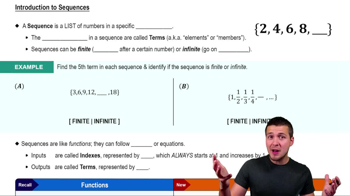
Introduction to Sequences

Squeeze Theorem

The Squeeze Theorem helps find limits by 'trapping' a sequence between two others that have the same limit. If aₙ ≤ bₙ ≤ cₙ for all n beyond some point, and both aₙ and cₙ converge to L, then bₙ also converges to L.
Video consigliato:
Percorso guidato
06:11
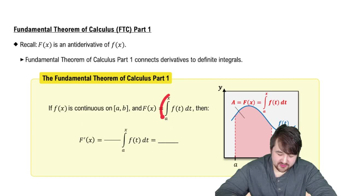
Fundamental Theorem of Calculus Part 1

Behavior of Trigonometric Functions in Limits

Trigonometric functions like sin(n) oscillate between -1 and 1 and do not have limits as n approaches infinity. When combined with sequences that tend to zero, their bounded nature allows the use of the Squeeze Theorem to evaluate the overall limit.
Video consigliato:
Percorso guidato
6:04
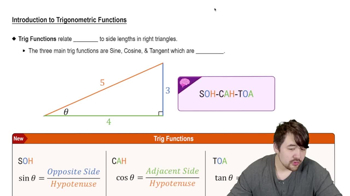
Introduction to Trigonometric Functions
Pratica correlata
Domanda del libro di testo

{Use of Tech} A savings plan

James begins a savings plan in which he deposits \$100 at the beginning of each month into an account that earns 9% interest annually, or equivalently, 0.75% per month.

To be clear, on the first day of each month, the bank adds 0.75% of the current balance as interest, and then James deposits \$100.


Let Bₙ be the balance in the account after the nᵗʰ payment, where B₀ = \$0.


a.Write the first five terms of the sequence {Bₙ}.

57
views
Domanda del libro di testo

27–37. Evaluating series Evaluate the following infinite series or state that the series diverges.

∑ (from k = 0 to ∞)(tan⁻¹(k + 2) − tan⁻¹k)

81
views
Domanda del libro di testo

27–37. Evaluating series Evaluate the following infinite series or state that the series diverges.

∑ (from k = 0 to ∞)((1/3)ᵏ + (4/3)ᵏ)

51
views
Domanda del libro di testo

27–34. Working with sequences Several terms of a sequence {aₙ}ₙ₌₁∞ are given.

a. Find the next two terms of the sequence.

{1, 2, 4, 8, 16, ......}

54
views
Domanda del libro di testo

41–44. {Use of Tech} Remainders and estimates Consider the following convergent series.


a. Find an upper bound for the remainder in terms of n.


41. ∑ (k = 1 to ∞) 1 / k⁶

105
views
Domanda del libro di testo

89–90. {Use of Tech} Lower and upper bounds of a series

For each convergent series and given value of n, complete the following.


c. Find lower and upper bounds (Lₙ and Uₙ respectively) for the exact value of the series.


89.∑ (from k = 1 to ∞)1 / k⁵ ;n = 5

104
views