
Ch. 11 - Power Series
Briggs - Calculus: Early Transcendentals 3rd Edition
Briggs3rd EditionCalculus: Early TranscendentalsISBN: 9780136847243Non è quello che usi tu?Cambia libro di testo
Capitolo 11, Problema 11.4.46

Approximating real numbers Use an appropriate Taylor series to find the first four nonzero terms of an infinite series that is equal to the following numbers.
√e

Guida verificata passo dopo passo
1
Recognize that \( \sqrt{e} \) can be rewritten as \( e^{1/2} \). This allows us to use the Taylor series expansion for \( e^x \) centered at \( x = 0 \).
Recall the Taylor series expansion for \( e^x \) about 0 is given by: \[ e^x = \sum_{n=0}^{\infty} \frac{x^n}{n!} = 1 + x + \frac{x^2}{2!} + \frac{x^3}{3!} + \cdots \]
To find the series for \( e^{1/2} \), substitute \( x = \frac{1}{2} \) into the series: \[ e^{1/2} = 1 + \frac{1}{2} + \frac{(1/2)^2}{2!} + \frac{(1/2)^3}{3!} + \cdots \]
Calculate each term up to the first four nonzero terms without simplifying the numerical values completely, so the terms are: \[ 1, \quad \frac{1}{2}, \quad \frac{(1/2)^2}{2!}, \quad \frac{(1/2)^3}{3!} \]
Write the first four nonzero terms of the infinite series as the approximation for \( \sqrt{e} \): \[ \sqrt{e} \approx 1 + \frac{1}{2} + \frac{1}{8} \cdot \frac{1}{2} + \frac{1}{16} \cdot \frac{1}{6} + \cdots \] (You can leave the terms in factorial and power form to keep the expression clear.)

Risposta video verificata per un problema simile:

Questa soluzione video è stata consigliata dai nostri tutor come utile per risolvere questo problema.
Durata del video:
1m

Concetti chiave

Ecco i concetti essenziali che devi comprendere per rispondere correttamente alla domanda.

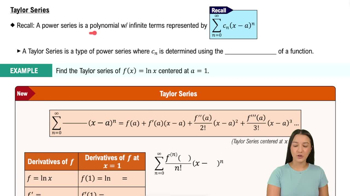
Taylor Series Expansion

A Taylor series represents a function as an infinite sum of terms calculated from the function's derivatives at a single point. It approximates functions near that point, allowing complex expressions to be expressed as polynomials. Understanding how to construct and use Taylor series is essential for approximating values like √e.
Video consigliato:
08:42
Taylor Series

Function Composition and Substitution in Series

To find the Taylor series of a composite function like √e, one often rewrites the expression in a form suitable for expansion, such as √(e) = (e^x)^(1/2). Substituting variables and manipulating the function helps apply known series expansions effectively, enabling the extraction of the first few nonzero terms.
Video consigliato:
Percorso guidato
06:00
Geometric Series

Binomial Series Expansion

The binomial series generalizes the expansion of expressions like (1 + x)^r for any real exponent r. It is particularly useful for functions involving roots or fractional powers, such as square roots. Using the binomial series allows the approximation of √(1 + x) and is key to finding the terms of the series for √e.
Video consigliato:
Percorso guidato
06:00
Geometric Series