
Ch. 11 - Power Series
Briggs - Calculus: Early Transcendentals 3rd Edition
Briggs3rd EditionCalculus: Early TranscendentalsISBN: 9780136847243Non è quello che usi tu?Cambia libro di testo
Capitolo 11, Problema 11.4.82

{Use of Tech} Newton's derivation of the sine and arcsine series Newton discovered the binomial series and then used it ingeniously to obtain many more results. Here is a case in point.
a. Referring to the figure, show that x = sin s or s = sin ⁻¹ x.
b. The area of a circular sector of radius r subtended by an angle θ is 1/2r²θ. Show that the area of the circular sector APE is s/2, which implies that
s = 2 ∫₀ˣ √(1 − t²) dt − x √(1 −x²)
c. Use the binomial series for f(x) = √(1 − x²) to obtain the first few terms of the Taylor series for s=sin ⁻¹ x.
d. Newton next inverted the series in part (c) to obtain the Taylor series for x=sin s. He did this by assuming sin s = ∑ aₖ sᵏ and solving x = sin(sin ⁻¹ x) for the coefficients aₖ. Find the first few terms of the Taylor series for sin s using this idea (a computer algebra system might be helpful as well).

Guida verificata passo dopo passo
1
Step 1: Understand the relationship between the variables in the figure. Since s is the angle subtended by the arc on the unit circle and x is the length of the vertical segment corresponding to sin s, we have the fundamental trigonometric identity: \(x = \sin s\). Consequently, this implies \(s = \sin^{-1} x\) because the arcsine function is the inverse of the sine function on the appropriate domain.
Step 2: Use the formula for the area of a circular sector. The area of a sector with radius \(r\) and angle \(\theta\) is given by \(\frac{1}{2} r^2 \theta\). For a unit circle (\(r=1\)), the area of sector APE is \(\frac{s}{2}\). Next, express this area in terms of an integral involving \(x\) and \(t\) by considering the area under the curve \(y = \sqrt{1 - t^2}\) from \(0\) to \(x\). This leads to the equation: \(s = 2 \int_0^x \sqrt{1 - t^2} \, dt - x \sqrt{1 - x^2}\).
Step 3: Expand the function \(f(x) = \sqrt{1 - x^2}\) using the binomial series. Recall the binomial series expansion for \((1 + u)^p\) is \(\sum_{n=0}^\infty \binom{p}{n} u^n\), where \(\binom{p}{n} = \frac{p(p-1)\cdots(p-n+1)}{n!}\). Here, set \(u = -x^2\) and \(p = \frac{1}{2}\). Write out the first few terms explicitly to approximate \(\sqrt{1 - x^2}\).
Step 4: Substitute the binomial series expansion of \(\sqrt{1 - t^2}\) into the integral expression for \(s\). Integrate term-by-term from \(0\) to \(x\) to find the series expansion for \(\int_0^x \sqrt{1 - t^2} \, dt\). Then, use this result along with the term \(x \sqrt{1 - x^2}\) to write the Taylor series for \(s = \sin^{-1} x\) up to the desired number of terms.
Step 5: To find the Taylor series for \(x = \sin s\), assume a power series form \(\sin s = \sum_{k=1}^\infty a_k s^k\). Substitute \(s = \sin^{-1} x\) from the series found in Step 4 into this assumed series and equate it to \(x\). By matching coefficients of powers of \(x\), solve for the coefficients \(a_k\). This inversion process recovers the Taylor series for \(\sin s\).

Risposta video verificata per un problema simile:

Questa soluzione video è stata consigliata dai nostri tutor come utile per risolvere questo problema.
Durata del video:
6m

Concetti chiave

Ecco i concetti essenziali che devi comprendere per rispondere correttamente alla domanda.

Inverse Trigonometric Functions

Inverse trigonometric functions, like arcsine, reverse the effect of trigonometric functions. For example, if x = sin s, then s = sin⁻¹ x. Understanding this relationship is crucial for expressing angles in terms of their sine values and for manipulating integrals and series involving these functions.
Video consigliato:
06:35
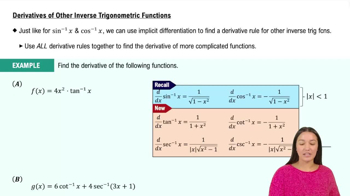
Derivatives of Other Inverse Trigonometric Functions

Area of a Circular Sector and Integral Representation

The area of a circular sector with radius r and angle θ is given by (1/2)r²θ. This geometric fact helps relate the angle s to an integral involving √(1 − t²), connecting geometry with calculus. Recognizing this allows the derivation of integral formulas for inverse trigonometric functions.
Video consigliato:
03:37
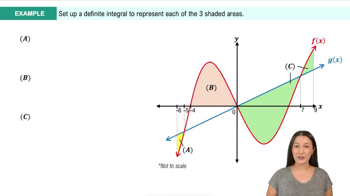
Finding Area Between Curves that Cross on the Interval Example 3

Binomial Series and Taylor Series Expansion

The binomial series generalizes the expansion of expressions like (1 + x)^n for any real exponent n. Applying it to f(x) = √(1 − x²) enables the derivation of a Taylor series for arcsine. Inverting this series yields the Taylor series for sine, illustrating how series expansions can be manipulated to find function representations.
Video consigliato:
08:42
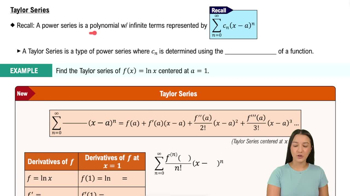
Taylor Series
Pratica correlata
Domanda del libro di testo

Exponential function In Section 11.3, we show that the power series for the exponential function centered at 0 is


eˣ = ∑ₖ₌₀∞ (xᵏ)/k!, for −∞ < x < ∞


Use the methods of this section to find the power series centered at 0 for the following functions. Give the interval of convergence for the resulting series.


f(x) = e⁻³ˣ

86
views
Domanda del libro di testo

Radius and interval of convergence Determine the radius and interval of convergence of the following power series.


∑ₖ₌₁∞ (3x + 2)ᵏ/k

50
views
Domanda del libro di testo

{Use of Tech} Approximating powers Compute the coefficients for the Taylor series for the following functions about the given point a, and then use the first four terms of the series to approximate the given number.

f(x) =∛x with a=64; approximate ∛60.

55
views
Domanda del libro di testo

Differential equations


a. Find a power series for the solution of the following differential equations, subject to the given initial condition

b. Identify the function represented by the power series.


y′(t) − y = 0, y(0) = 2

69
views
Domanda del libro di testo

Working with binomial series Use properties of power series, substitution, and factoring to find the first four nonzero terms of the Maclaurin series for the following functions. Use the Maclaurin series


(1 + x)⁻² = 1 − 2x + 3x² − 4x³ + ⋯, for −1 < x < 1.


(1 + 4x)⁻²

59
views
Domanda del libro di testo

Inverse sine Given the power series

1/√(1 − x²) = 1 + (1/2)x² + (1 ⋅ 3)/(2 ⋅ 4) x⁴ + (1 ⋅ 3 ⋅ 5)/(2 ⋅ 4 ⋅ 6) x⁶ +⋯

for −1<x<1, find the power series for f(x) = sin ⁻¹ x centered at 0.

65
views