


The height above the ground of a stone thrown upwards is given by s(t), where t is measured in seconds. After 1 second, the height of the stone is 48 feet above the ground, and after 1.5 seconds, the height of the stone is 60 feet above the ground. Evaluate s(1) and s(1.5), and then find the average velocity of the stone over the time interval [1, 1.5].
Ch. 2 - Limits
Briggs3rd EditionCalculus: Early TranscendentalsISBN: 9780136847243Non è quello che usi tu?Cambia libro di testo
Capitolo 2, Problema 2.R.83
b. Estimate a solution to the equation in the given interval using a root finder.
x=cos x; (0,π/2)
Guida verificata passo dopo passo1
Identify the function for which we need to find the root. In this case, the function is f(x) = x - cos(x). We are looking for a value of x where f(x) = 0.
Choose a numerical method to estimate the root. A common method is the bisection method, which is suitable for continuous functions on a closed interval where the function changes sign.
Set the initial interval as given: [a, b] = [0, π/2]. Check the values of f(a) and f(b) to ensure that they have opposite signs, confirming that a root exists in the interval.
Apply the bisection method: Calculate the midpoint c = (a + b) / 2. Evaluate f(c). If f(c) is close to zero (within a desired tolerance), c is an approximate root. Otherwise, determine the subinterval [a, c] or [c, b] where the sign change occurs and repeat the process.
Continue iterating the bisection method, narrowing down the interval until the midpoint c is sufficiently close to the actual root, as determined by your tolerance level.

Risposta video verificata per un problema simile:
Questa soluzione video è stata consigliata dai nostri tutor come utile per risolvere questo problema.
Durata del video:
4mConcetti chiave
Ecco i concetti essenziali che devi comprendere per rispondere correttamente alla domanda.
Root Finding
Root finding is a numerical method used to determine the values of a variable that make a function equal to zero. In this context, we are looking for the value of x that satisfies the equation x = cos(x) within the interval (0, π/2). Common methods for root finding include the bisection method, Newton's method, and the secant method, each with its own advantages and limitations.
Video consigliato:
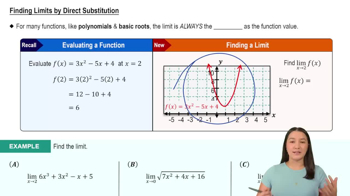
Finding Limits by Direct Substitution
Fixed Point Iteration
Fixed point iteration is a technique used to find solutions to equations of the form x = g(x). In this case, we can rearrange the equation x = cos(x) to g(x) = cos(x). By iteratively substituting values into g(x), we can converge to a fixed point, which represents the solution to the original equation. This method is particularly useful when the function g(x) is continuous and the interval is chosen appropriately.
Video consigliato:
Critical Points
Interval and Convergence
The interval (0, π/2) is crucial for ensuring that the root finding method converges to a solution. Within this interval, the function f(x) = x - cos(x) is continuous and changes sign, indicating the presence of a root according to the Intermediate Value Theorem. Understanding the behavior of the function within the specified interval helps in selecting the appropriate numerical method and ensuring that the iterations lead to a valid solution.
Video consigliato:
Percorso guidato
Derivatives
Pratica correlata
Domanda del libro di testo
252
views
Domanda del libro di testo
Suppose the rental cost for a snowboard is \$25 for the first day (or any part of the first day) plus \$15 for each additional day (or any part of a day).
e. For what values of t is f continuous? Explain.
266
views
Domanda del libro di testo
Evaluate and.
242
views
Domanda del libro di testo
Let . <IMAGE>
Calculate for each value of in the following table.
377
views
Domanda del libro di testo
Let .
Determine values of the constants and , if possible, for which is continuous at .
361
views
Domanda del libro di testo
Find the intervals on which the following functions are continuous. Specify right- or left-continuity at the finite endpoints.
353
views
