

Ch. 2 - Limits
Briggs - Calculus: Early Transcendentals 3rd Edition
Briggs3rd EditionCalculus: Early TranscendentalsISBN: 9780136847243Non è quello che usi tu?Cambia libro di testo
Capitolo 2, Problema 2.5.61

Determine the end behavior of the following transcendental functions by analyzing appropriate limits. Then provide a simple sketch of the associated graph, showing asymptotes if they exist. 
f(x)=sinxf\(\left\)(x\(\right\))=\(\sin\) x

Guida verificata passo dopo passo
1
Step 1: Understand the function f(x) = sin(x). The sine function is periodic with a period of 2π, meaning it repeats its values every 2π units along the x-axis.
Step 2: Analyze the range of the sine function. The sine function oscillates between -1 and 1 for all x, so its range is [-1, 1].
Step 3: Determine the end behavior by considering the limits as x approaches positive and negative infinity. Since sin(x) is periodic and bounded, it does not approach a specific value as x approaches infinity or negative infinity.
Step 4: Identify any asymptotes. The sine function does not have any vertical or horizontal asymptotes because it is bounded and periodic.
Step 5: Sketch the graph of f(x) = sin(x). Draw a wave-like pattern oscillating between -1 and 1, repeating every 2π along the x-axis, with no asymptotes.

Risposta video verificata per un problema simile:

Questa soluzione video è stata consigliata dai nostri tutor come utile per risolvere questo problema.
Durata del video:
12m

Concetti chiave

Ecco i concetti essenziali che devi comprendere per rispondere correttamente alla domanda.

End Behavior of Functions

End behavior refers to the behavior of a function as the input values approach positive or negative infinity. Understanding end behavior is crucial for analyzing limits and determining how a function behaves at its extremes. For example, knowing whether a function approaches a specific value, diverges, or oscillates helps in sketching its graph accurately.
Video consigliato:
5:46
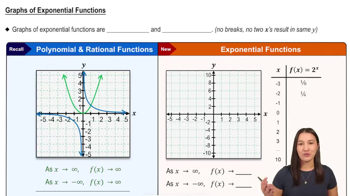
Graphs of Exponential Functions

Limits

Limits are fundamental in calculus, representing the value that a function approaches as the input approaches a certain point. They are essential for understanding continuity, derivatives, and integrals. In the context of transcendental functions like sine, limits help determine the function's behavior at infinity, which is vital for analyzing end behavior.
Video consigliato:
05:50
One-Sided Limits

Asymptotes

Asymptotes are lines that a graph approaches but never touches, indicating the behavior of a function as it extends towards infinity. They can be vertical, horizontal, or oblique, depending on the function's characteristics. Identifying asymptotes is important for sketching graphs accurately, especially for functions that exhibit unbounded behavior or oscillation.
Video consigliato:
Percorso guidato
5:37
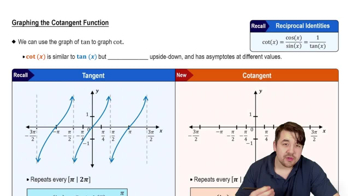
Introduction to Cotangent Graph
Pratica correlata
Domanda del libro di testo

If a function f represents a system that varies in time, the existence of lim limt→∞f(t){\(\displaystyle\[\lim\)_{t\(\rightarrow\]\infty\)}{f(t)}} means that the system reaches a steady state (or equilibrium). For the following systems, determine whether a steady state exists and give the steady-state value.


The population of a culture of tumor cells is given by p(t)=3500tt+1p\(\left\)(t\(\right\))=\(\frac{3500t}{t+1}\).

373
views
Domanda del libro di testo

Evaluate each limit and justify your answer. 

lim x→2 (3 / 2x^5−4x^2−50)^4

349
views
Domanda del libro di testo

Use the definitions given in Exercise 57 to prove the following infinite limits.


lim x→1^+ 1 /1 − x=−∞

297
views
Domanda del libro di testo

Find all vertical asymptotes x=ax=a of the following functions. For each value of aa, determine limx→a+f(x){\(\displaystyle\)\(\lim\)_{x\(\to\) a^{+}}}f\(\left\)(x\(\right\)), limx→a−f(x){\(\displaystyle\)\(\lim\)_{x\(\to\) a^{-}}}f\(\left\)(x\(\right\)), and limx→af(x){\(\displaystyle\)\(\lim\)_{x\(\to\) a}}f\(\left\)(x\(\right\)).

f(x)=x+1x3−4x2+4xf\(\left\)(x\(\right\))=\(\frac{x+1}{x^3-4x^2+4x}\)

347
views
Domanda del libro di testo

Use the precise definition of a limit to prove the following limits. Specify a relationship between ε and δ that guarantees the limit exists.

lim x→7 f(x)=9, where f(x)={3x−12 if x≤7

x+2 if x>7

365
views
Domanda del libro di testo

Use the precise definition of infinite limits to prove the following limits.


limx→0(1x4−sin(x))=∞{\(\displaystyle\[\lim\)_{x\(\to\)0}}\(\left\)(\(\frac{1}{x^4}\)-\(\sin\]\left\)(x\(\right\))\(\right\))=\(\infty\)

322
views