Ch. 2 - Limits
Briggs - Calculus: Early Transcendentals 3rd Edition
Briggs3rd EditionCalculus: Early TranscendentalsISBN: 9780136847243Non è quello che usi tu?Cambia libro di testo
Capitolo 2, Problema 2.7.41

Use the precise definition of a limit to prove the following limits. Specify a relationship between ε and δ that guarantees the limit exists.
lim x→1 x^4=1

Guida verificata passo dopo passo
1
Step 1: Recall the precise definition of a limit. For the limit \( \lim_{{x \to 1}} x^4 = 1 \) to hold, for every \( \varepsilon > 0 \), there must exist a \( \delta > 0 \) such that whenever \( 0 < |x - 1| < \delta \), it follows that \( |x^4 - 1| < \varepsilon \).
Step 2: Start by expressing \( |x^4 - 1| \) in a form that can be manipulated. Notice that \( x^4 - 1 = (x^2 - 1)(x^2 + 1) = (x - 1)(x + 1)(x^2 + 1) \).
Step 3: To ensure \( |x^4 - 1| < \varepsilon \), we need to bound \( |(x - 1)(x + 1)(x^2 + 1)| \). Assume \( |x - 1| < 1 \), which implies \( 0 < x < 2 \). This gives us bounds for \( |x + 1| \) and \( |x^2 + 1| \).
Step 4: Calculate the bounds: \( |x + 1| < 3 \) and \( |x^2 + 1| < 5 \) when \( 0 < x < 2 \). Therefore, \( |(x - 1)(x + 1)(x^2 + 1)| < |x - 1| \cdot 3 \cdot 5 = 15|x - 1| \).
Step 5: To satisfy \( |x^4 - 1| < \varepsilon \), choose \( \delta = \frac{\varepsilon}{15} \). This ensures that whenever \( 0 < |x - 1| < \delta \), it follows that \( |x^4 - 1| < \varepsilon \), thus proving the limit.

Risposta video verificata per un problema simile:

Questa soluzione video è stata consigliata dai nostri tutor come utile per risolvere questo problema.
Durata del video:
5m

Concetti chiave

Ecco i concetti essenziali che devi comprendere per rispondere correttamente alla domanda.

Limit Definition

The precise definition of a limit states that for a function f(x) to approach a limit L as x approaches a value c, for every ε > 0, there exists a δ > 0 such that if 0 < |x - c| < δ, then |f(x) - L| < ε. This formalism is crucial for proving limits rigorously.
Video consigliato:
05:50
One-Sided Limits

Epsilon-Delta Relationship

In the context of limits, the ε (epsilon) represents how close f(x) must be to the limit L, while δ (delta) represents how close x must be to c. Establishing a relationship between ε and δ is essential to demonstrate that as x gets sufficiently close to c, f(x) will be within ε of L.
Video consigliato:
Percorso guidato
05:53
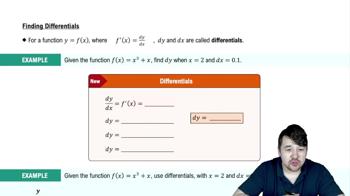
Finding Differentials

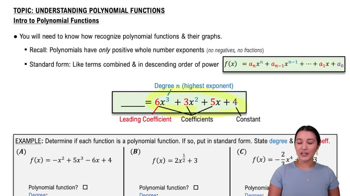
Polynomial Functions

Polynomial functions, such as f(x) = x^4, are continuous everywhere on their domain. This property simplifies limit calculations, as the limit of a polynomial as x approaches a point can be found by direct substitution, making it easier to apply the ε-δ definition.
Video consigliato:
6:04
Introduction to Polynomial Functions
Pratica correlata
Domanda del libro di testo

b. Estimate a solution to the equation in the given interval using a root finder.


x^5+7x+5=0; (−1,0)

226
views

Domanda del libro di testo

Determine the following limits.

lim θ→π/2 sin^2 θ − 5 sin θ + 4 / sin^2 θ − 1

367
views
Domanda del libro di testo

Determine the interval(s) on which the following functions are continuous. 

f(x)=1 / x^2−4

320
views
Domanda del libro di testo

If a function f represents a system that varies in time, the existence of lim limt→∞f(t){\(\displaystyle\[\lim\)_{t\(\rightarrow\]\infty\)}{f(t)}} means that the system reaches a steady state (or equilibrium). For the following systems, determine whether a steady state exists and give the steady-state value.


The population of a bacteria culture is given by p(t)=2500t+1p\(\left\)(t\(\right\))=\(\frac{2500}{t+1}\).

400
views
Domanda del libro di testo

A sequence is an infinite, ordered list of numbers that is often defined by a function. For example, the sequence {2,4,6,8,…} is specified by the function f(n) = 2n, where n=1,2,3,….The limit of such a sequence is lim n→∞ f(n), provided the limit exists. All the limit laws for limits at infinity may be applied to limits of sequences. Find the limit of the following sequences or state that the limit does not exist. 


{2,3/4,4/9,5/16,…}, which is defined by f(n) = (n+1) / n^2, for n=1,2,3,…

308
views
Domanda del libro di testo

Suppose limx→a f(x)=L{\(\displaystyle\)\(\lim\)_{x\(\to\) a}}\(\text{ }\)f\(\left\)(x\(\right\))=L and limx→a g(x)=M{\(\displaystyle\)\(\lim\)_{x\(\to\) a}}\(\text{ }\)g\(\left\)(x\(\right\))=M. Prove that limx→a (f(x)−g(x))=L−M{\(\displaystyle\[\lim\)_{x\(\to\) a}}\(\text{ }\]\left\)(f\(\left\)(x\(\right\))-g\(\left\)(x\(\right\))\(\right\))=L-M.

345
views