Ch. 3 - Derivatives
Briggs - Calculus: Early Transcendentals 3rd Edition
Briggs3rd EditionCalculus: Early TranscendentalsISBN: 9780136847243Non è quello che usi tu?Cambia libro di testo
Capitolo 3, Problema 3.8.39

27–40. Implicit differentiation Use implicit differentiation to find dy/dx.
√x⁴+y² = 5x+2y³

Guida verificata passo dopo passo
1
Start by differentiating both sides of the equation with respect to x. Remember that y is a function of x, so when differentiating terms involving y, use the chain rule.
Differentiate the left side: For √(x⁴ + y²), use the chain rule. The derivative of √u with respect to u is 1/(2√u), and then multiply by the derivative of the inside function (x⁴ + y²) with respect to x.
Differentiate the right side: For 5x + 2y³, differentiate each term separately. The derivative of 5x with respect to x is 5, and for 2y³, use the chain rule: differentiate y³ with respect to y, which is 3y², and then multiply by dy/dx.
Set the derivatives from both sides equal to each other. This will give you an equation involving dy/dx.
Solve the resulting equation for dy/dx. This will involve isolating dy/dx on one side of the equation, which may require algebraic manipulation.

Risposta video verificata per un problema simile:

Questa soluzione video è stata consigliata dai nostri tutor come utile per risolvere questo problema.
Durata del video:
9m

Concetti chiave

Ecco i concetti essenziali che devi comprendere per rispondere correttamente alla domanda.

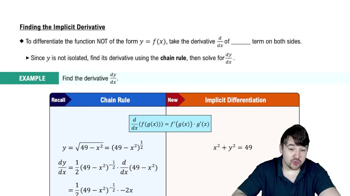
Implicit Differentiation

Implicit differentiation is a technique used to differentiate equations where the dependent and independent variables are not explicitly separated. Instead of solving for one variable in terms of the other, we differentiate both sides of the equation with respect to the independent variable, applying the chain rule as necessary. This method is particularly useful for equations that are difficult or impossible to rearrange.
Video consigliato:
Percorso guidato
05:14
Finding The Implicit Derivative

Chain Rule

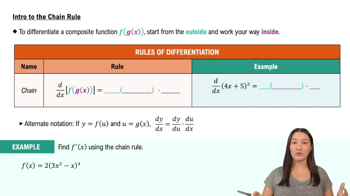
The chain rule is a fundamental principle in calculus that allows us to differentiate composite functions. It states that if a function y is defined as a function of u, which in turn is a function of x, then the derivative of y with respect to x can be found by multiplying the derivative of y with respect to u by the derivative of u with respect to x. This is essential in implicit differentiation when dealing with terms involving y.
Video consigliato:
05:02
Intro to the Chain Rule

Derivative Notation (dy/dx)

The notation dy/dx represents the derivative of y with respect to x, indicating the rate of change of y as x changes. In the context of implicit differentiation, dy/dx is treated as a variable that can be solved for, even when y is not explicitly defined in terms of x. Understanding this notation is crucial for interpreting the results of differentiation and for solving for the slope of the tangent line at a given point.
Video consigliato: