Ch. 3 - Derivatives
Briggs - Calculus: Early Transcendentals 3rd Edition
Briggs3rd EditionCalculus: Early TranscendentalsISBN: 9780136847243Non è quello che usi tu?Cambia libro di testo
Capitolo 3, Problema 3.10.62b

62–65. {Use of Tech} Graphing f and f'
b. Compute and graph f'.
f(x) = (x−1) sin^−1 x on [−1,1]

Guida verificata passo dopo passo
1
First, understand the function f(x) = (x - 1) * sin^(-1)(x). This function is defined on the interval [-1, 1] because the inverse sine function, sin^(-1)(x), is only defined for x in [-1, 1].
To find the derivative f'(x), apply the product rule. The product rule states that if you have a function h(x) = u(x) * v(x), then h'(x) = u'(x) * v(x) + u(x) * v'(x). Here, let u(x) = x - 1 and v(x) = sin^(-1)(x).
Calculate the derivatives: u'(x) = 1 and v'(x) = 1 / sqrt(1 - x^2). The derivative of sin^(-1)(x) is 1 / sqrt(1 - x^2).
Apply the product rule: f'(x) = (x - 1) * (1 / sqrt(1 - x^2)) + 1 * sin^(-1)(x). Simplify this expression to get the final form of f'(x).
Use graphing technology to plot both f(x) and f'(x) on the interval [-1, 1]. Observe the behavior of the function and its derivative, noting any critical points or changes in concavity.

Risposta video verificata per un problema simile:

Questa soluzione video è stata consigliata dai nostri tutor come utile per risolvere questo problema.
Durata del video:
9m

Concetti chiave

Ecco i concetti essenziali che devi comprendere per rispondere correttamente alla domanda.

Derivative

The derivative of a function measures how the function's output value changes as its input value changes. It is defined as the limit of the average rate of change of the function over an interval as the interval approaches zero. In this context, computing the derivative f' of the function f(x) = (x−1) sin^−1 x will provide insights into the function's behavior, such as its increasing or decreasing nature.
Video consigliato:

Graphing Functions

Graphing a function involves plotting its output values against its input values on a coordinate plane. For the function f(x) = (x−1) sin^−1 x, this means calculating f(x) for various x values within the interval [-1, 1] and representing these points visually. Understanding how to graph both f and its derivative f' helps in analyzing the function's characteristics, such as local maxima and minima.
Video consigliato:
Percorso guidato
5:53
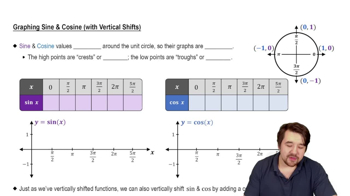
Graph of Sine and Cosine Function

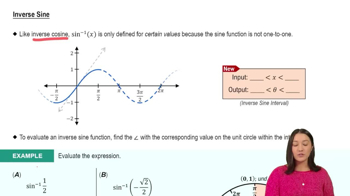
Inverse Sine Function

The inverse sine function, denoted as sin^−1 x or arcsin x, is the function that returns the angle whose sine is x. It is defined for x in the range [-1, 1], producing outputs in the range [-π/2, π/2]. In the given function f(x), the presence of sin^−1 x means that the behavior of f will be influenced by the properties of the inverse sine function, particularly its shape and limits within the specified interval.
Video consigliato:
4:03
Inverse Sine
Pratica correlata
Domanda del libro di testo

60–62. {Use of Tech} Multiple tangent lines Complete the following steps. <IMAGE>

b. Graph the tangent lines on the given graph.

x+y³−y=1; x=1

170
views

Domanda del libro di testo

{Use of Tech} Hours of daylight The number of hours of daylight at any point on Earth fluctuates throughout the year. In the Northern Hemisphere, the shortest day is on the winter solstice and the longest day is on the summer solstice. At 40° north latitude, the length of a day is approximated by D(t) = 12−3 cos (2π(t+10) / 365), where D is measured in hours and 0≤t≤365 is measured in days, with t=0 corresponding to January 1.

b. Find the rate at which the daylight function changes.

389
views
Domanda del libro di testo

Use a graphing utility to plot the curve and the tangent line.

y = cos x / 1−cos x; x = π/3

278
views
Domanda del libro di testo

13-26 Implicit differentiation Carry out the following steps.

b. Find the slope of the curve at the given point.

x⁴+y⁴ = 2;(1,−1)

277
views
Domanda del libro di testo

Vertical tangent lines

b. Does the curve have any horizontal tangent lines? Explain.

426
views
Domanda del libro di testo

109-112 {Use of Tech} Calculating limits The following limits are the derivatives of a composite function g at a point a.

b. Use the Chain Rule to find each limit. Verify your answer by using a calculator.

limh→013((1+h)5+7)10−13(8)10h{\(\displaystyle\)\(\lim\)_{h\(\to\)0}}\(\frac{\frac{1}{3\left(\left(1+h\right)^5+7\right)^{10}\)}-\(\frac{1}{3\left(8\right)^{10}\)}}{h}

242
views