Ch. 3 - Derivatives
Briggs - Calculus: Early Transcendentals 3rd Edition
Briggs3rd EditionCalculus: Early TranscendentalsISBN: 9780136847243Non è quello che usi tu?Cambia libro di testo
Capitolo 3, Problema 3.10.65b

62–65. {Use of Tech} Graphing f and f'
b. Compute and graph f'.
f(x)=e^−x tan^−1 x on [0,∞)

Guida verificata passo dopo passo
1
Step 1: Understand the function f(x) = e^(-x) * tan^(-1)(x). This function is a product of two functions: e^(-x) and tan^(-1)(x). To find the derivative f'(x), we will use the product rule.
Step 2: Recall the product rule for derivatives, which states that if you have two functions u(x) and v(x), then the derivative of their product is given by (uv)' = u'v + uv'. Here, let u(x) = e^(-x) and v(x) = tan^(-1)(x).
Step 3: Compute the derivative of u(x) = e^(-x). The derivative u'(x) is found using the chain rule: u'(x) = -e^(-x).
Step 4: Compute the derivative of v(x) = tan^(-1)(x). The derivative v'(x) is 1/(1 + x^2).
Step 5: Apply the product rule to find f'(x): f'(x) = u'(x)v(x) + u(x)v'(x) = (-e^(-x))tan^(-1)(x) + e^(-x)/(1 + x^2). Now, use a graphing tool to plot both f(x) and f'(x) over the interval [0, ∞).

Risposta video verificata per un problema simile:

Questa soluzione video è stata consigliata dai nostri tutor come utile per risolvere questo problema.
Durata del video:
8m

Concetti chiave

Ecco i concetti essenziali che devi comprendere per rispondere correttamente alla domanda.

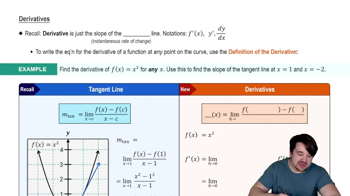
Derivative

The derivative of a function measures how the function's output changes as its input changes. It is defined as the limit of the average rate of change of the function over an interval as the interval approaches zero. For the function f(x) = e^(-x) * arctan(x), the derivative f'(x) can be computed using the product rule and chain rule of differentiation.
Video consigliato:

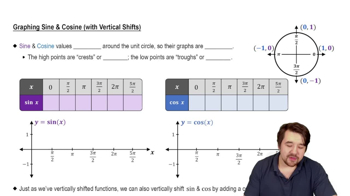
Graphing Functions

Graphing a function involves plotting its output values against its input values on a coordinate system. For the function f(x) = e^(-x) * arctan(x), understanding its behavior as x approaches 0 and infinity is crucial. The graph of f' will provide insights into the function's increasing or decreasing behavior, as well as its critical points.
Video consigliato:
Percorso guidato
5:53
Graph of Sine and Cosine Function

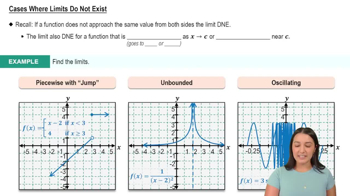
Behavior at Infinity

Analyzing the behavior of a function as x approaches infinity helps determine its long-term trends. For f(x) = e^(-x) * arctan(x), as x increases, e^(-x) approaches 0, while arctan(x) approaches π/2. This interplay affects the overall behavior of f and its derivative f', which is essential for understanding the function's limits and asymptotic behavior.
Video consigliato:
03:07
Cases Where Limits Do Not Exist