
Ch. 3 - Derivatives
Briggs - Calculus: Early Transcendentals 3rd Edition
Briggs3rd EditionCalculus: Early TranscendentalsISBN: 9780136847243Non è quello che usi tu?Cambia libro di testo
Capitolo 3, Problema 3.11.26b

A bug is moving along the right side of the parabola y=x² at a rate such that its distance from the origin is increasing at 1 cm/min.
b. Use the equation y=x² to find an equation relating dy/dt to dx/dt.

Guida verificata passo dopo passo
1
Start by understanding the problem: We have a bug moving along the parabola y = x², and its distance from the origin is increasing at a rate of 1 cm/min. We need to find a relationship between dy/dt and dx/dt.
Recall that the distance from the origin to a point (x, y) on the parabola is given by the distance formula: d = √(x² + y²). Since y = x², substitute y in the distance formula to get d = √(x² + (x²)²) = √(x² + x⁴).
Differentiate the distance formula with respect to time t to find the rate of change of distance: d(d)/dt = (1/2) * (1/√(x² + x⁴)) * (2x * dx/dt + 4x³ * dx/dt). Set this equal to 1 cm/min, as given in the problem.
Now, differentiate the equation y = x² with respect to time t to find dy/dt: dy/dt = 2x * dx/dt.
Combine the results from the differentiation of the distance formula and the parabola equation to express dy/dt in terms of dx/dt. Use the fact that d(d)/dt = 1 cm/min to solve for dy/dt in terms of dx/dt.

Risposta video verificata per un problema simile:

Questa soluzione video è stata consigliata dai nostri tutor come utile per risolvere questo problema.
Durata del video:
5m

Concetti chiave

Ecco i concetti essenziali che devi comprendere per rispondere correttamente alla domanda.

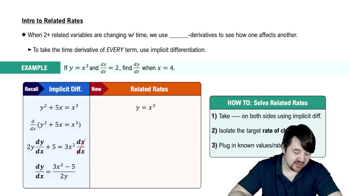
Related Rates

Related rates involve finding the rate at which one quantity changes in relation to another. In this problem, we need to relate the rates of change of the bug's position along the parabola (dx/dt and dy/dt) to its distance from the origin. This concept is essential for setting up the equations that will allow us to solve for the desired rates.
Video consigliato:
Percorso guidato
04:16
Intro To Related Rates

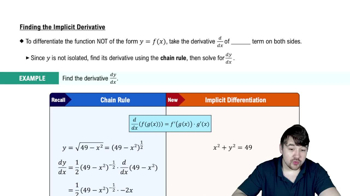
Implicit Differentiation

Implicit differentiation is a technique used to differentiate equations that define y implicitly in terms of x. Since the bug's position is described by the equation y = x², we can differentiate both sides with respect to time t to find a relationship between dy/dt and dx/dt. This method is crucial for relating the rates of change in this context.
Video consigliato:
Percorso guidato
05:14
Finding The Implicit Derivative

Distance Formula

The distance formula calculates the distance between two points in a coordinate system. In this scenario, the distance from the origin to the bug's position on the parabola can be expressed as D = √(x² + y²). Understanding this formula is vital for determining how the distance changes over time, which is central to solving the problem.
Video consigliato:
5:04
Converting between Degrees & Radians