Ch. 3 - Derivatives
Briggs - Calculus: Early Transcendentals 3rd Edition
Briggs3rd EditionCalculus: Early TranscendentalsISBN: 9780136847243Non è quello che usi tu?Cambia libro di testo
Capitolo 3, Problema 3.10.13

Evaluate the derivative of the following functions.
f(x) = sin-1 2x

Guida verificata passo dopo passo
1
Step 1: Recognize that \( f(x) = \sin^{-1}(2x) \) is the inverse sine function, also known as arcsine, applied to \( 2x \).
Step 2: Recall the derivative formula for the inverse sine function: \( \frac{d}{dx}[\sin^{-1}(u)] = \frac{1}{\sqrt{1-u^2}} \cdot \frac{du}{dx} \), where \( u \) is a function of \( x \).
Step 3: Identify \( u = 2x \) in this problem, so you need to find \( \frac{du}{dx} \).
Step 4: Differentiate \( u = 2x \) with respect to \( x \), which gives \( \frac{du}{dx} = 2 \).
Step 5: Substitute \( u = 2x \) and \( \frac{du}{dx} = 2 \) into the derivative formula: \( \frac{d}{dx}[\sin^{-1}(2x)] = \frac{1}{\sqrt{1-(2x)^2}} \cdot 2 \).

Risposta video verificata per un problema simile:

Questa soluzione video è stata consigliata dai nostri tutor come utile per risolvere questo problema.
Durata del video:
2m

Concetti chiave

Ecco i concetti essenziali che devi comprendere per rispondere correttamente alla domanda.

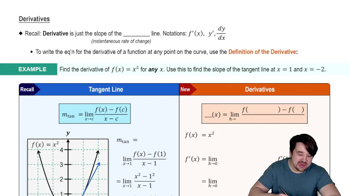
Derivative

The derivative of a function measures how the function's output value changes as its input value changes. It is defined as the limit of the average rate of change of the function over an interval as the interval approaches zero. In calculus, the derivative is often denoted as f'(x) or df/dx, and it provides critical information about the function's behavior, such as its slope and points of tangency.
Video consigliato:

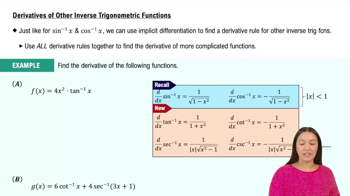
Inverse Trigonometric Functions

Inverse trigonometric functions, such as sin<sup>-1</sup>(x), are the functions that reverse the action of the standard trigonometric functions. For example, sin<sup>-1</sup>(x) gives the angle whose sine is x. These functions have specific domains and ranges, and their derivatives can be derived using implicit differentiation or known derivative formulas, which are essential for evaluating derivatives involving these functions.
Video consigliato:
06:35
Derivatives of Other Inverse Trigonometric Functions

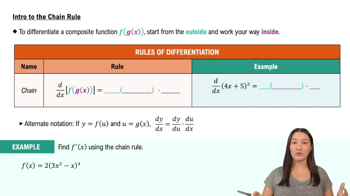
Chain Rule

The chain rule is a fundamental technique in calculus used to differentiate composite functions. It states that if a function y = f(g(x)) is composed of two functions, the derivative can be found by multiplying the derivative of the outer function f with the derivative of the inner function g. This rule is particularly useful when dealing with functions like sin<sup>-1</sup>(2x), where the inner function (2x) must be differentiated alongside the outer function (sin<sup>-1</sup>), requiring careful application of the chain rule.
Video consigliato:
05:02
Intro to the Chain Rule