Ch. 3 - Derivatives
Briggs - Calculus: Early Transcendentals 3rd Edition
Briggs3rd EditionCalculus: Early TranscendentalsISBN: 9780136847243Non è quello che usi tu?Cambia libro di testo
Capitolo 3, Problema 3.6.55b

{Use of Tech} Spring oscillations A spring hangs from the ceiling at equilibrium with a mass attached to its end. Suppose you pull downward on the mass and release it 10 inches below its equilibrium position with an upward push. The distance x (in inches) of the mass from its equilibrium position after t seconds is given by the function x(t) = 10sin t - 10cos t, where x is positive when the mass is above the equilibrium position. <IMAGE>
b. Find dx/dt and interpret the meaning of this derivative.  

Guida verificata passo dopo passo
1
To find the derivative dx/dt, we need to differentiate the function x(t) = 10sin(t) - 10cos(t) with respect to t. This involves applying the basic rules of differentiation to each term separately.
Differentiate the first term: The derivative of 10sin(t) with respect to t is 10cos(t). This is because the derivative of sin(t) is cos(t), and the constant 10 remains as a coefficient.
Differentiate the second term: The derivative of -10cos(t) with respect to t is 10sin(t). This is because the derivative of cos(t) is -sin(t), and the constant -10 changes sign to become 10.
Combine the derivatives: The derivative dx/dt is the sum of the derivatives of each term, which gives us dx/dt = 10cos(t) + 10sin(t).
Interpret the meaning: The derivative dx/dt represents the rate of change of the distance x with respect to time t. In the context of the spring oscillation, it indicates the velocity of the mass at any given time t. A positive value of dx/dt means the mass is moving upward, while a negative value means it is moving downward.

Risposta video verificata per un problema simile:

Questa soluzione video è stata consigliata dai nostri tutor come utile per risolvere questo problema.
Durata del video:
3m

Concetti chiave

Ecco i concetti essenziali che devi comprendere per rispondere correttamente alla domanda.

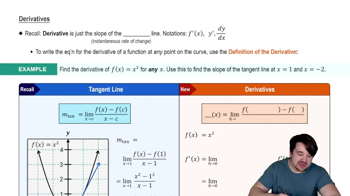
Derivatives

A derivative represents the rate of change of a function with respect to a variable. In this context, dx/dt indicates how the position of the mass changes over time. It provides insight into the velocity of the mass as it oscillates, showing whether the mass is moving upward or downward at any given moment.
Video consigliato:

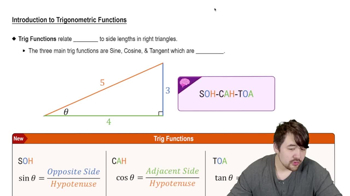
Trigonometric Functions

The function x(t) = 10sin(t) - 10cos(t) involves sine and cosine, which are fundamental trigonometric functions. These functions describe periodic motion, such as oscillations, and are essential for modeling the behavior of the mass on the spring. Understanding their properties helps in analyzing the motion's amplitude and frequency.
Video consigliato:
Percorso guidato
6:04
Introduction to Trigonometric Functions

Equilibrium Position

The equilibrium position is the point where the forces acting on the mass are balanced, resulting in no net force. In this scenario, it is the position where the spring is neither compressed nor stretched. Understanding this concept is crucial for analyzing the oscillatory motion, as it serves as the reference point for measuring displacement and determining the nature of the oscillations.
Video consigliato:
Percorso guidato
06:29
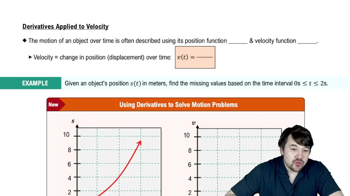
Derivatives Applied To Velocity
Pratica correlata
Domanda del libro di testo

Derivatives and tangent lines

a. For the following functions and values of a, find f′(a).

f(x) = 8x; a = −3

227
views

Domanda del libro di testo

97–100. Logistic growth Scientists often use the logistic growth function P(t) = P₀K / P₀+(K−P₀)e^−r₀t to model population growth, where P₀ is the initial population at time t=0, K is the carrying capacity, and r₀ is the base growth rate. The carrying capacity is a theoretical upper bound on the total population that the surrounding environment can support. The figure shows the sigmoid (S-shaped) curve associated with a typical logistic model. <IMAGE>


{Use of Tech} Gone fishing When a reservoir is created by a new dam, 50 fish are introduced into the reservoir, which has an estimated carrying capacity of 8000 fish. A logistic model of the fish population is P(t) = 400,000 / 50+7950e^−0.5t, where t is measured in years.


b. How long does it take for the population to reach 5000 fish? How long does it take for the population to reach 90% of the carrying capacity?

170
views
Domanda del libro di testo

45–50. Tangent lines Carry out the following steps. <IMAGE>

b. Determine an equation of the line tangent to the curve at the given point.

x³+y³=2xy; (1, 1)

269
views
Domanda del libro di testo

Use definition (1) (p. 133) to find the slope of the line tangent to the graph of f at P.

f(x) = -3x2 - 5x + 1; P(1,-7)

218
views
Domanda del libro di testo

21–30. Derivatives

b. Evaluate f'(a) for the given values of a.

f(x) = 1/x+1; a = -1/2;5

317
views
Domanda del libro di testo

45–50. Tangent lines Carry out the following steps. <IMAGE>

b. Determine an equation of the line tangent to the curve at the given point.

x⁴-x²y+y⁴=1; (−1, 1)

220
views