
Ch. 4 - Applications of the Derivative
Briggs - Calculus: Early Transcendentals 3rd Edition
Briggs3rd EditionCalculus: Early TranscendentalsISBN: 9780136847243Non è quello che usi tu?Cambia libro di testo
Capitolo 4, Problema 4.9.109a

107–110. {Use of Tech} Motion with gravity Consider the following descriptions of the vertical motion of an object subject only to the acceleration due to gravity. Begin with the acceleration equation a(t) = v' (t) = -g , where g = 9.8 m/s² .
a. Find the velocity of the object for all relevant times. 
A payload is released at an elevation of 400 m from a hot-air balloon that is rising at a rate of 10 m/s.

Guida verificata passo dopo passo
1
Start with the given acceleration equation: a(t)=-g, where g is the acceleration due to gravity, 9.8 m/s². This equation represents the rate of change of velocity with respect to time.
Integrate the acceleration equation to find the velocity function. The integral of -g with respect to time t is -gt+C, where C is the constant of integration.
Determine the constant of integration C using the initial velocity of the object. The payload is released from a hot-air balloon that is rising at a rate of 10 m/s, so the initial velocity v(0) is 10 m/s. Substitute t=0 and v(0)=10 into the velocity equation to solve for C.
Substitute the value of C back into the velocity equation. The velocity function will now be expressed as -gt+10, where g is 9.8 m/s².
Interpret the velocity function. This equation describes the velocity of the payload at any time t after it is released. The negative term -gt accounts for the deceleration due to gravity, while the constant term 10 represents the initial upward velocity of the payload.

Risposta video verificata per un problema simile:

Questa soluzione video è stata consigliata dai nostri tutor come utile per risolvere questo problema.
Durata del video:
3m

Concetti chiave

Ecco i concetti essenziali che devi comprendere per rispondere correttamente alla domanda.

Acceleration due to Gravity

Acceleration due to gravity, denoted as 'g', is the rate at which an object accelerates towards the Earth when in free fall. On Earth, this value is approximately 9.8 m/s². This constant is crucial for understanding the motion of objects under the influence of gravity, as it determines how quickly their velocity changes over time.
Video consigliato:
Percorso guidato
06:51
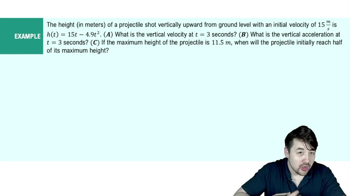
Derivatives Applied To Acceleration Example 2

Velocity Function

The velocity function describes the speed and direction of an object's motion at any given time. It is derived from the acceleration function by integrating the acceleration with respect to time. In this context, finding the velocity involves integrating the constant acceleration due to gravity, which will yield a linear function representing the object's velocity over time.
Video consigliato:
Percorso guidato
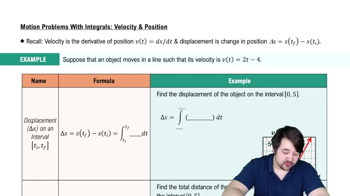
10:17
Using The Velocity Function

Initial Conditions

Initial conditions are the starting values that define the state of a system at the beginning of an observation. In this problem, the initial conditions include the initial height of the payload (400 m) and the initial velocity (10 m/s upward). These conditions are essential for solving the motion equations, as they allow for the accurate determination of the object's position and velocity at any time during its descent.
Video consigliato:
Percorso guidato
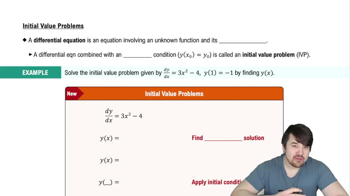
05:03
Initial Value Problems
Pratica correlata
Domanda del libro di testo

Folded boxes


a. Squares with sides of length x are cut out of each corner of a rectangular piece of cardboard measuring 5 ft by 8 ft. The resulting piece of cardboard is then folded into a box without a lid. Find the volume of the largest box that can be formed in this way.

319
views
Domanda del libro di testo

Optimal soda can


a. Classical problem Find the radius and height of a cylindrical soda can with a volume of 354 cm³ that minimize the surface area.

292
views
Domanda del libro di testo

Maximizing profit Suppose a tour guide has a bus that holds a maximum of 100 people. Assume his profit (in dollars) for taking people on a city tour is P(n) = n(50 - 0.5n) - 100. (Although P is defined only for positive integers, treat it as a continuous function.)


a. How many people should the guide take on a tour to maximize the profit?

342
views
Domanda del libro di testo

Values of related functions Suppose f is differentiable on (-∞,∞) and assume it has a local extreme value at the point x = 2, where f(2) = 0. Let g(x) = xf(x) + 1 and let h(x) = xf(x) + x +1, for all values of x.


a. Evaluate g(2), h(2), g'(2), and h'(2).

240
views
Domanda del libro di testo

Sketch a graph of a function f with the following properties.


f' < 0 and f" < 0, for x < 3

347
views
Domanda del libro di testo

Suppose the objective function P= xy is subject to the constraint 10x + y = 100, where x and y are real numbers.


a. Eliminate the variable y from the objective function so that P is expressed as a function of one variable x.

276
views