Ch. 4 - Applications of the Derivative
Briggs - Calculus: Early Transcendentals 3rd Edition
Briggs3rd EditionCalculus: Early TranscendentalsISBN: 9780136847243Non è quello che usi tu?Cambia libro di testo
Capitolo 4, Problema 19

Use ƒ' and ƒ" to complete parts (a) and (b). 


a. Find the intervals on which f is increasing and the intervals on which it is decreasing.


b. Find the intervals on which f is concave up and the intervals on which it is concave down.


ƒ(x) = x⁹/9 + 3x⁵ - 16x

Guida verificata passo dopo passo
1
First, find the first derivative ƒ'(x) of the function ƒ(x) = \( \frac{x^9}{9} + 3x^5 - 16x \). Use the power rule for differentiation: \( \frac{d}{dx} x^n = nx^{n-1} \).
Calculate ƒ'(x): \( \frac{d}{dx} \left( \frac{x^9}{9} \right) = x^8 \), \( \frac{d}{dx} (3x^5) = 15x^4 \), and \( \frac{d}{dx} (-16x) = -16 \). Therefore, ƒ'(x) = x^8 + 15x^4 - 16.
To find the intervals where ƒ is increasing or decreasing, solve ƒ'(x) = 0 to find critical points. Analyze the sign of ƒ'(x) in each interval determined by these critical points.
Next, find the second derivative ƒ''(x) to determine concavity. Differentiate ƒ'(x): \( \frac{d}{dx} (x^8) = 8x^7 \), \( \frac{d}{dx} (15x^4) = 60x^3 \), and \( \frac{d}{dx} (-16) = 0 \). Thus, ƒ''(x) = 8x^7 + 60x^3.
To find intervals of concavity, solve ƒ''(x) = 0 to find inflection points. Analyze the sign of ƒ''(x) in each interval determined by these inflection points to determine where the function is concave up or concave down.

Risposta video verificata per un problema simile:

Questa soluzione video è stata consigliata dai nostri tutor come utile per risolvere questo problema.
Durata del video:
10m

Concetti chiave

Ecco i concetti essenziali che devi comprendere per rispondere correttamente alla domanda.

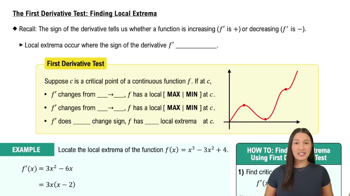
First Derivative Test

The First Derivative Test involves analyzing the first derivative of a function, ƒ'(x), to determine where the function is increasing or decreasing. If ƒ'(x) > 0 on an interval, the function is increasing; if ƒ'(x) < 0, it is decreasing. Critical points, where ƒ'(x) = 0 or is undefined, are key to identifying these intervals.
Video consigliato:
07:09
The First Derivative Test: Finding Local Extrema

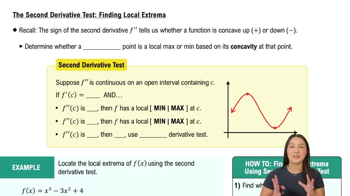
Second Derivative Test

The Second Derivative Test uses the second derivative, ƒ''(x), to assess the concavity of a function. If ƒ''(x) > 0, the function is concave up, indicating that the slope of the tangent line is increasing. Conversely, if ƒ''(x) < 0, the function is concave down, suggesting that the slope is decreasing. Points where ƒ''(x) = 0 may indicate inflection points.
Video consigliato:
06:02
The Second Derivative Test: Finding Local Extrema

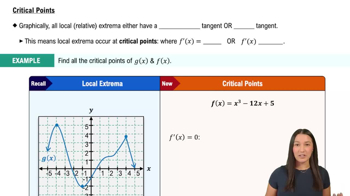
Critical Points

Critical points are values of x where the first derivative ƒ'(x) is zero or undefined. These points are essential for determining intervals of increase and decrease, as well as for analyzing concavity. By evaluating the behavior of the function around these points, one can classify them as local maxima, minima, or points of inflection.
Video consigliato:
04:50
Critical Points