Ch. 5 - Integration
Briggs - Calculus: Early Transcendentals 3rd Edition
Briggs3rd EditionCalculus: Early TranscendentalsISBN: 9780136847243Non è quello che usi tu?Cambia libro di testo
Capitolo 5, Problema 5.1.69a

Approximating areas Estimate the area of the region bounded by the graph of ƒ(𝓍) = x² + 2 and the x-axis on [0, 2] in the following ways.
(a) Divide [0, 2] into n = 4 subintervals and approximate the area of the region using a left Riemann sum. Illustrate the solution geometrically.

Guida verificata passo dopo passo
1
First, divide the interval [0, 2] into 4 equal subintervals. Since the length of the interval is 2, each subinterval will have width \(\Delta x = \frac{2 - 0}{4} = 0.5\).
Identify the left endpoints of each subinterval. These will be \(x_0 = 0\), \(x_1 = 0.5\), \(x_2 = 1.0\), and \(x_3 = 1.5\). Note that the left Riemann sum uses the function values at these points.
Evaluate the function \(f(x) = x^2 + 2\) at each left endpoint: calculate \(f(x_0)\), \(f(x_1)\), \(f(x_2)\), and \(f(x_3)\).
Multiply each function value by the width \(\Delta x\) to find the area of each rectangle: \(f(x_i) \times \Delta x\) for \(i = 0, 1, 2, 3\).
Sum all these rectangle areas to approximate the total area under the curve on [0, 2]: \(\text{Left Riemann Sum} = \sum_{i=0}^{3} f(x_i) \Delta x\). This sum represents the approximate area bounded by the graph and the x-axis.

Risposta video verificata per un problema simile:

Questa soluzione video è stata consigliata dai nostri tutor come utile per risolvere questo problema.
Durata del video:
4m

Concetti chiave

Ecco i concetti essenziali che devi comprendere per rispondere correttamente alla domanda.

Riemann Sums

Riemann sums approximate the area under a curve by dividing the interval into subintervals and summing the areas of rectangles formed using function values at specific points. The left Riemann sum uses the left endpoint of each subinterval to determine the rectangle height, providing an estimate of the integral.
Video consigliato:
Percorso guidato
06:11
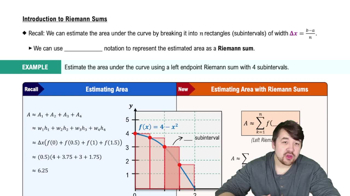
Introduction to Riemann Sums

Partitioning the Interval

Partitioning involves dividing the interval [0, 2] into equal subintervals, here n = 4, to create smaller segments for approximation. Each subinterval has length Δx = (b - a)/n, which is essential for calculating the width of rectangles in the Riemann sum.
Video consigliato:
08:44
Interval of Convergence

Function Evaluation at Endpoints

To compute the left Riemann sum, evaluate the function f(x) = x² + 2 at the left endpoints of each subinterval. These values determine the heights of the rectangles, which when multiplied by the subinterval width and summed, approximate the total area under the curve.
Video consigliato:
Percorso guidato
4:26
Evaluating Composed Functions
Pratica correlata
Domanda del libro di testo

Using properties of integrals Use the value of the first integral I to evaluate the two given integrals. 

I = ∫₀¹ (𝓍³ ― 2𝓍) d𝓍 = ―3/4

(a) ∫₀¹ (4𝓍―2𝓍³) d𝓍

110
views

Domanda del libro di testo

Area functions for linear functions Consider the following functions ƒ and real numbers a (see figure).

(a) Find and graph the area function A (𝓍) = ∫ₐˣ ƒ(t) dt .

ƒ(t) = 2t + 5 , a = 0

105
views
Domanda del libro di testo

{Use of Tech} Approximating definite integrals with a calculator Consider the following definite integrals.

(a) Write the left and right Riemann sums in sigma notation for an arbitrary value of n.


∫₀¹ cos ⁻¹ 𝓍 d𝓍

57
views
Domanda del libro di testo

Average value with a parameter Consider the function ƒ(𝓍) = a𝓍 (1―𝓍) on the interval [0, 1], where a is a positive real number.

(a) Find the average value of ƒ as a function of a .

84
views
Domanda del libro di testo

Working with area functions Consider the function ƒ and the points a, b, and c.

(a) Find the area function A (𝓍) = ∫ₐˣ ƒ(t) dt using the Fundamental Theorem.

ƒ(𝓍) = cos 𝓍 ; a = 0 , b = π/2 , c = π

38
views
Domanda del libro di testo

Mass from density A thin 10-cm rod is made of an alloy whose density varies along its length according to the function shown in the figure. Assume density is measured in units of g/cm. In Chapter 6, we show that the mass of the rod is the area under the density curve.

(a) Find the mass of the left half of the rod (0 ≤ x ≤ 5) .

63
views