

Ch. 5 - Integration
Briggs - Calculus: Early Transcendentals 3rd Edition
Briggs3rd EditionCalculus: Early TranscendentalsISBN: 9780136847243Non è quello che usi tu?Cambia libro di testo
Capitolo 5, Problema 5.3.66

Area Find (i) the net area and (ii) the area of the following regions. Graph the function and indicate the region in question.


The region bounded by y = 6 cos 𝓍 and the 𝓍-axis between 𝓍 = ―π/2 and 𝓍 = π

Guida verificata passo dopo passo
1
Step 1: Understand the problem. You are tasked with finding (i) the net area and (ii) the total area of the region bounded by the function y = 6 cos(𝓍) and the 𝓍-axis between 𝓍 = -π/2 and 𝓍 = π. The net area accounts for signed areas (positive above the 𝓍-axis and negative below), while the total area considers only the magnitude of the regions.
Step 2: Graph the function y = 6 cos(𝓍) over the interval [-π/2, π]. The cosine function oscillates between -1 and 1, and multiplying by 6 scales the amplitude to [-6, 6]. Identify where the function crosses the 𝓍-axis (i.e., where y = 0) within the interval. These points divide the region into subintervals where the function is either positive or negative.
Step 3: Set up the integral for the net area. The net area is calculated using the definite integral of y = 6 cos(𝓍) over the interval [-π/2, π]. Use the formula: ∫a-π/2bπ6cosπ
Step 4: Set up the integral for the total area. To find the total area, you need to integrate the absolute value of y = 6 cos(𝓍) over the interval [-π/2, π]. This requires splitting the integral into subintervals where the function is positive and negative, and then taking the absolute value of the function in the negative subinterval. Use the formula: ∫a-π/2bπ6cosπ
Step 5: Solve the integrals. For the net area, evaluate the definite integral of 6 cos(𝓍) over [-π/2, π]. For the total area, split the integral into subintervals where the function is positive and negative, and evaluate the absolute value of the function in the negative subinterval. Combine the results to find the total area. Ensure proper use of trigonometric identities and integration rules.

Risposta video verificata per un problema simile:

Questa soluzione video è stata consigliata dai nostri tutor come utile per risolvere questo problema.
Durata del video:
7m

Concetti chiave

Ecco i concetti essenziali che devi comprendere per rispondere correttamente alla domanda.

Definite Integral

The definite integral is a fundamental concept in calculus that represents the net area under a curve between two specified limits. It is calculated using the integral symbol and provides a way to quantify the accumulation of quantities, such as area, over an interval. In this context, it will be used to find the area between the curve y = 6 cos x and the x-axis from x = -π/2 to x = π.
Video consigliato:
Percorso guidato
05:43
Definition of the Definite Integral

Net Area vs. Total Area

Net area refers to the signed area between a curve and the x-axis, where areas above the x-axis are positive and those below are negative. In contrast, total area considers all areas as positive, regardless of their position relative to the x-axis. Understanding this distinction is crucial for accurately calculating the areas in the given problem, especially since the cosine function oscillates above and below the x-axis.
Video consigliato:
02:59
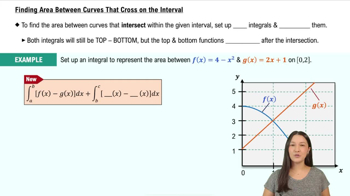
Finding Area Between Curves that Cross on the Interval

Graphing Trigonometric Functions

Graphing trigonometric functions, such as y = 6 cos x, involves plotting the function's values over a specified interval to visualize its behavior. This includes identifying key features like amplitude, period, and intercepts. For this problem, graphing the function will help in understanding the regions bounded by the curve and the x-axis, which is essential for determining both the net and total areas.
Video consigliato:
Percorso guidato
6:04
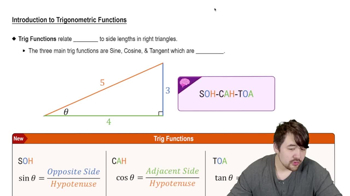
Introduction to Trigonometric Functions
Pratica correlata
Domanda del libro di testo

{Use of Tech} Sigma notation for Riemann sums Use sigma notation to write the following Riemann sums. Then evaluate each Riemann sum using Theorem 5.1 or a calculator.

The right Riemann sum for ƒ(𝓍)) = x + 1 on [0, 4] with n = 50.

95
views
Domanda del libro di testo

Use a substitution of the form u = a𝓍 + b to evaluate the following indefinite integrals

∫(e³ˣ ⁺¹ d𝓍

61
views
Domanda del libro di testo

Integrals with sin² 𝓍 and cos² 𝓍 Evaluate the following integrals.                                                                                                             


 ∫ 𝓍 cos²𝓍² d𝓍

81
views
Domanda del libro di testo

Symmetry of composite functions Prove that the integrand is either even or odd. Then give the value of the integral or show how it can be simplified. Assume f and g are even functions and p and q are odd functions.


∫ᵃ₋ₐ ƒ(g(𝓍)) d𝓍

143
views
Domanda del libro di testo

Derivatives of integrals Simplify the following expressions.


d/d𝓍 ∫₀ˣ (√1 + t²) dt (Hint: ∫ˣ₋ₓ (√1 + t²) dt = ∫⁰₋ₓ (√1 + t²) dt + ∫ˣ₋ₓ (√1 + t²) dt ) .

60
views
Domanda del libro di testo

Suppose the interval [1, 3] is partitioned into n = 4 subintervals. What is the subinterval length ∆𝓍? List the grid points x₀ , x₁ , x₂ , x₃ and x₄. Which points are used for the left, right, and midpoint Riemann sums?

85
views