Ch. 5 - Integration
Briggs - Calculus: Early Transcendentals 3rd Edition
Briggs3rd EditionCalculus: Early TranscendentalsISBN: 9780136847243Non è quello che usi tu?Cambia libro di testo
Capitolo 5, Problema 5.3.47

Definite integrals Evaluate the following integrals using the Fundamental Theorem of Calculus


∫₁² 3/t dt

Guida verificata passo dopo passo
1
Step 1: Identify the integral to be evaluated. The problem asks us to compute the definite integral ∫₁² (3/t) dt using the Fundamental Theorem of Calculus.
Step 2: Recall the Fundamental Theorem of Calculus, which states that if F(x) is an antiderivative of f(x), then ∫ₐᵇ f(x) dx = F(b) - F(a).
Step 3: Find the antiderivative of the integrand 3/t. The antiderivative of 1/t is ln|t|, so the antiderivative of 3/t is 3 * ln|t|.
Step 4: Apply the Fundamental Theorem of Calculus. Substitute the limits of integration into the antiderivative: F(2) - F(1), where F(t) = 3 * ln|t|.
Step 5: Simplify the expression by evaluating 3 * ln|2| - 3 * ln|1|. Note that ln|1| equals 0, so the result simplifies further.

Risposta video verificata per un problema simile:

Questa soluzione video è stata consigliata dai nostri tutor come utile per risolvere questo problema.
Durata del video:
1m

Concetti chiave

Ecco i concetti essenziali che devi comprendere per rispondere correttamente alla domanda.

Definite Integrals

Definite integrals represent the signed area under a curve between two specified limits. They are calculated using the integral symbol with lower and upper bounds, indicating the interval over which the function is evaluated. The result of a definite integral is a numerical value that quantifies this area, which can be interpreted in various contexts, such as physics and economics.
Video consigliato:
Percorso guidato
05:43
Definition of the Definite Integral

Fundamental Theorem of Calculus

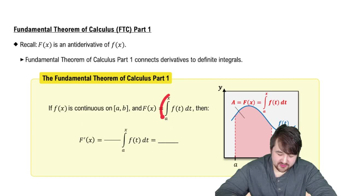
The Fundamental Theorem of Calculus links differentiation and integration, providing a method to evaluate definite integrals. It states that if a function is continuous on an interval, the integral of its derivative over that interval equals the difference in the values of the original function at the endpoints. This theorem allows us to compute definite integrals by finding an antiderivative of the integrand.
Video consigliato:
Percorso guidato
06:11
Fundamental Theorem of Calculus Part 1

Antiderivatives

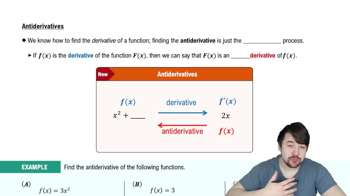
An antiderivative of a function is another function whose derivative is the original function. Finding an antiderivative is essential for evaluating definite integrals using the Fundamental Theorem of Calculus. For example, if we need to integrate a function like 3/t, we seek a function whose derivative gives us 3/t, which in this case is 3 ln|t|. Evaluating the definite integral then involves substituting the limits into this antiderivative.
Video consigliato:
Percorso guidato
05:50
Antiderivatives
Pratica correlata
Domanda del libro di testo

Determine the intervals on which the function g(𝓍) = ∫ₓ⁰ t / (t² + 1) dt  is concave up or concave down.

49
views

Domanda del libro di testo

Evaluate


lim [ ∫₂ˣ √(t² + t + 3dt) ] / (𝓍² ―4)

𝓍→2

45
views
Domanda del libro di testo

Definite integrals Evaluate the following integrals using the Fundamental Theorem of Calculus


∫₁² (z² + 4) / z dz

116
views
Domanda del libro di testo

Definite integrals Use geometry (not Riemann sums) to evaluate the following definite integrals. Sketch a graph of the integrand, show the region in question, and interpret your result.


 ∫₀⁴ ƒ(𝓍) d𝓍, where ƒ(𝓍) = {5      if 𝓍 ≤ 2                                                                                                                                                                                     

                      3𝓍 ― 1  if 𝓍 > 2

147
views
Domanda del libro di testo

Average distance on a triangle Consider the right triangle with vertices (0,0) ,(0,b) , and (a,0) , where a > 0 and b > 0. Show that the average vertical distance from points on the 𝓍-axis to the hypotenuse is b/2 , for all a > 0 .

49
views
Domanda del libro di testo

Approximating displacement The velocity of an object is given by the following functions on a specified interval. Approximate the displacement of the object on this interval by subdividing the interval into n subintervals. Use the left endpoint of each subinterval to compute the height of the rectangles.

v = 2t + 1(m/s), for 0 ≤ t ≤ 8 ; n = 2

84
views