Ch. 5 - Integration
Briggs - Calculus: Early Transcendentals 3rd Edition
Briggs3rd EditionCalculus: Early TranscendentalsISBN: 9780136847243Non è quello che usi tu?Cambia libro di testo
Capitolo 5, Problema 5.2.59

Definite integrals from graphs The figure shows the areas of regions bounded by the graph of ƒ and the 𝓍-axis. Evaluate the following integrals.


∫₀ᵃ ƒ(𝓍) d𝓍

Guida verificata passo dopo passo
1
Identify the regions bounded by the graph of the function ƒ(𝓍) and the 𝓍-axis between 𝓍 = 0 and 𝓍 = a. Note whether these regions lie above or below the 𝓍-axis, as this affects the sign of the integral.
Recall that the definite integral ∫₀ᵃ ƒ(𝓍) d𝓍 represents the net area between the curve and the 𝓍-axis from 0 to a. Areas above the axis contribute positively, while areas below contribute negatively.
Determine the numerical values of the areas shown in the figure for each region between 0 and a. Assign positive values to areas above the axis and negative values to areas below the axis.
Sum all these signed areas to find the value of the definite integral ∫₀ᵃ ƒ(𝓍) d𝓍. This sum represents the net area under the curve from 0 to a.
Write the final expression for the integral as the sum of these areas, ensuring to include the correct signs based on the position relative to the 𝓍-axis.

Risposta video verificata per un problema simile:

Questa soluzione video è stata consigliata dai nostri tutor come utile per risolvere questo problema.
Durata del video:
1m

Concetti chiave

Ecco i concetti essenziali che devi comprendere per rispondere correttamente alla domanda.

Definite Integral as Net Area

A definite integral from a to b of a function f(x) represents the net area between the graph of f and the x-axis over [a, b]. Areas above the x-axis contribute positively, while areas below contribute negatively, resulting in the integral's value.
Video consigliato:
Percorso guidato
05:43
Definition of the Definite Integral

Interpreting Graphs for Integration

When evaluating integrals from graphs, it is essential to identify the regions bounded by the curve and the x-axis, noting their shapes and whether they lie above or below the axis. This helps in calculating areas accurately, often by summing or subtracting given region areas.
Video consigliato:
Percorso guidato
06:15
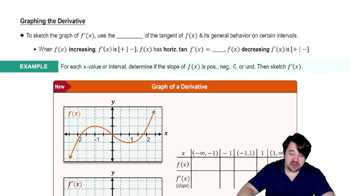
Graphing The Derivative

Properties of Definite Integrals

Definite integrals have properties such as additivity over intervals and sign changes when limits are reversed. Understanding these properties allows breaking complex integrals into simpler parts and correctly combining areas to find the total integral value.
Video consigliato:
Percorso guidato
05:43
Definition of the Definite Integral
Pratica correlata
Domanda del libro di testo

Indefinite integrals Use a change of variables or Table 5.6 to evaluate the following indefinite integrals. Check your work by differentiating.                                                                                  


 ∫ sec 4w tan 4w dw

55
views

Domanda del libro di testo

Symmetry in integrals Use symmetry to evaluate the following integrals.

∫²₋₂ [(x³ ― 4x) / (x² + 1)] dx 

134
views
Domanda del libro di testo

Average value of the derivative Suppose ƒ ' is a continuous function for all real numbers. Show that the average value of the derivative on an interval [a, b] is ƒ⁻' = (ƒ(b) ―ƒ(a))/ (b―a) . Interpret this result in terms of secant lines.

128
views
Domanda del libro di testo

General results Evaluate the following integrals in which the function ƒ is unspecified. Note that ƒ⁽ᵖ⁾ is the pth derivative of ƒ and ƒᵖ is the pth power of ƒ. Assume ƒ and its derivatives are continuous for all real numbers. 

∫ (5 ƒ³ (𝓍) + 7ƒ² (𝓍) + ƒ (𝓍 )) ƒ'(𝓍) d𝓍

85
views
Domanda del libro di testo

Indefinite integrals Use a change of variables or Table 5.6 to evaluate the following indefinite integrals. Check your work by differentiating.                                                                                  


 ∫ (sin⁵ 𝓍 + 3 sin³ 𝓍― sin 𝓍) cos 𝓍 d𝓍

74
views
Domanda del libro di testo

Use the given substitution to evaluate the following indefinite integrals. Check your answer by differentiating.                                                                                              


 ∫ (6𝓍 + 1) √(3𝓍² + 𝓍) d𝓍 , u = 3𝓍² + 𝓍

52
views