Ch. 5 - Integration
Briggs - Calculus: Early Transcendentals 3rd Edition
Briggs3rd EditionCalculus: Early TranscendentalsISBN: 9780136847243Non è quello che usi tu?Cambia libro di testo
Capitolo 5, Problema 5.5.49

Definite integrals Use a change of variables or Table 5.6 to evaluate the following definite integrals.                                                                                                                         
                                                                                                                                                                              
 ∫₁³ ( 2ˣ / 2ˣ + 4 ) d𝓍

Guida verificata passo dopo passo
1
Step 1: Observe the integral ∫₁³ (2ˣ / (2ˣ + 4)) d𝓍. To simplify this, consider using a substitution method. Let u = 2ˣ + 4, which simplifies the denominator.
Step 2: Differentiate u with respect to x. Since u = 2ˣ + 4, du/dx = ln(2) * 2ˣ. Rearrange to express dx in terms of du: dx = du / (ln(2) * 2ˣ).
Step 3: Substitute u and dx into the integral. Replace 2ˣ in the numerator and denominator using the substitution u = 2ˣ + 4. The integral becomes ∫ (1 / u) * (du / ln(2)).
Step 4: Factor out constants from the integral. The constant 1/ln(2) can be factored out, leaving (1/ln(2)) ∫ (1/u) du.
Step 5: Evaluate the integral of 1/u with respect to u. The result is ln|u|. Substitute back u = 2ˣ + 4 and apply the limits of integration (x = 1 to x = 3) to find the definite integral.

Risposta video verificata per un problema simile:

Questa soluzione video è stata consigliata dai nostri tutor come utile per risolvere questo problema.
Durata del video:
3m

Concetti chiave

Ecco i concetti essenziali che devi comprendere per rispondere correttamente alla domanda.

Definite Integrals

A definite integral represents the signed area under a curve between two specified limits. It is denoted as ∫_a^b f(x) dx, where 'a' and 'b' are the lower and upper limits, respectively. The result of a definite integral is a numerical value that quantifies the accumulation of the function's values over the interval [a, b].
Video consigliato:
Percorso guidato
05:43
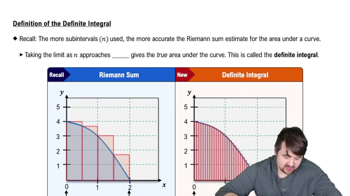
Definition of the Definite Integral

Change of Variables

Change of variables, or substitution, is a technique used in integration to simplify the integrand. By substituting a new variable for an existing one, the integral can often be transformed into a more manageable form. This method is particularly useful when dealing with complex functions or when the limits of integration need to be adjusted accordingly.
Video consigliato:
Percorso guidato
06:35
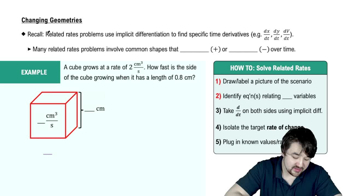
Changing Geometries

Integration Techniques

Integration techniques encompass various methods used to evaluate integrals, including substitution, integration by parts, and using tables of integrals. These techniques help in solving integrals that may not be straightforward. Familiarity with these methods, such as those found in Table 5.6, allows for efficient evaluation of definite integrals in calculus.
Video consigliato:
Percorso guidato
06:18
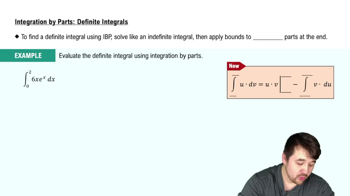
Integration by Parts for Definite Integrals
Pratica correlata
Domanda del libro di testo

Definite integrals Evaluate the following integrals using the Fundamental Theorem of Calculus


∫₋₂⁻¹ 𝓍⁻³ d𝓍

86
views
Domanda del libro di testo

Does a right Riemann sum underestimate or overestimate the area of the region under the graph of a function that is positive and decreasing on an interval [a,b]? Explain.

128
views
Domanda del libro di testo

Definite integrals Use a change of variables or Table 5.6 to evaluate the following definite integrals.                                                                                                                         


 ∫π/₄^π/² (cos 𝓍) / (sin² 𝓍) d𝓍

70
views
Domanda del libro di testo

A midpoint Riemann sum Approximate the area of the region bounded by the graph of ƒ(𝓍) = 100 ― x² and the x-axis on [0, 10] with n = 5 subintervals. Use the midpoint of each subinterval to determine the height of each rectangle (see figure).

111
views
Domanda del libro di testo

Symmetry in integrals Use symmetry to evaluate the following integrals.

∫₋π/₄^π/⁴ sec² x dx

95
views
Domanda del libro di testo

Indefinite integrals Use a change of variables or Table 5.6 to evaluate the following indefinite integrals. Check your work by differentiating.                                                                                  


 ∫ d𝓍 / (√1 ― 9𝓍²)

92
views