Ch. 5 - Integration
Briggs - Calculus: Early Transcendentals 3rd Edition
Briggs3rd EditionCalculus: Early TranscendentalsISBN: 9780136847243Non è quello che usi tu?Cambia libro di testo
Capitolo 5, Problema 5.R.35

Find the intervals on which ƒ(𝓍) = ∫ₓ¹ (t―3) (t―6)¹¹ dt is increasing and the intervals on which it is decreasing.

Guida verificata passo dopo passo
1
Step 1: Recognize that the function ƒ(𝓍) is defined as a definite integral with a variable upper limit. To determine where ƒ(𝓍) is increasing or decreasing, we need to compute its derivative using the Fundamental Theorem of Calculus.
Step 2: Apply the Fundamental Theorem of Calculus, which states that if ƒ(𝓍) = ∫ₓ¹ g(t) dt, then ƒ'(𝓍) = -g(𝓍). Here, g(t) = (t - 3)(t - 6)¹¹, so ƒ'(𝓍) = -(𝓍 - 3)(𝓍 - 6)¹¹.
Step 3: Analyze the sign of ƒ'(𝓍) to determine where ƒ(𝓍) is increasing or decreasing. ƒ(𝓍) is increasing when ƒ'(𝓍) > 0 and decreasing when ƒ'(𝓍) < 0. This requires solving the inequality -(𝓍 - 3)(𝓍 - 6)¹¹ > 0 and -(𝓍 - 3)(𝓍 - 6)¹¹ < 0.
Step 4: Examine the critical points of ƒ'(𝓍). The factors (𝓍 - 3) and (𝓍 - 6)¹¹ determine the behavior of ƒ'(𝓍). Note that (𝓍 - 6)¹¹ is always non-negative because it is raised to an odd power. The sign of ƒ'(𝓍) depends on the factor -(𝓍 - 3).
Step 5: Determine the intervals of increase and decrease by testing the sign of ƒ'(𝓍) in the intervals divided by the critical points 𝓍 = 3 and 𝓍 = 6. Summarize the intervals where ƒ'(𝓍) > 0 (increasing) and ƒ'(𝓍) < 0 (decreasing).

Risposta video verificata per un problema simile:

Questa soluzione video è stata consigliata dai nostri tutor come utile per risolvere questo problema.
Durata del video:
7m

Concetti chiave

Ecco i concetti essenziali che devi comprendere per rispondere correttamente alla domanda.

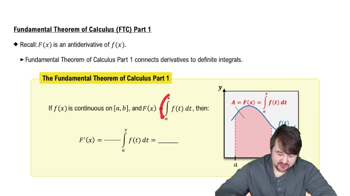
Fundamental Theorem of Calculus

The Fundamental Theorem of Calculus links the concept of differentiation and integration, stating that if a function is continuous on an interval, then the integral of its derivative over that interval gives the net change of the function. This theorem allows us to evaluate the integral and find the function's behavior based on its derivative.
Video consigliato:
Percorso guidato
06:11
Fundamental Theorem of Calculus Part 1

Derivative and Increasing/Decreasing Functions

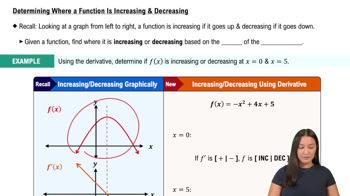
A function is increasing on an interval if its derivative is positive throughout that interval, and decreasing if its derivative is negative. By analyzing the sign of the derivative, we can determine where the function is rising or falling, which is essential for solving the given problem regarding the intervals of increase and decrease.
Video consigliato:
07:32
Determining Where a Function is Increasing & Decreasing

Critical Points

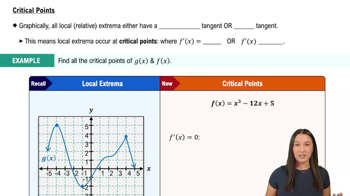
Critical points occur where the derivative of a function is zero or undefined. These points are crucial for determining the intervals of increase and decrease, as they can indicate potential local maxima or minima. By evaluating the derivative at these points, we can ascertain the behavior of the function around them.
Video consigliato:
04:50
Critical Points
Pratica correlata
Domanda del libro di testo

Evaluating integrals Evaluate the following integrals.


∫₀^²π cos² 𝓍/6 d𝓍

56
views
Domanda del libro di testo

Area of regions Compute the area of the region bounded by the graph of ƒ and the 𝓍-axis on the given interval. You may find it useful to sketch the region.                                              


 ƒ(𝓍) = 16―𝓍² on [―4, 4]

105
views
Domanda del libro di testo

Properties of integrals Suppose ∫₁⁴ ƒ(𝓍) d𝓍 = 6 , ∫₁⁴ g(𝓍) d𝓍 = 4 and ∫₃⁴ ƒ(𝓍) d𝓍 = 2 . Evaluate the following integrals or state that there is not enough information.


―∫₄¹ 2ƒ(𝓍) d𝓍

66
views
Domanda del libro di testo

Limit definition of the definite integral Use the limit definition of the definite integral with right Riemann sums and a regular partition to evaluate the following definite integrals. Use the Fundamental Theorem of Calculus to check your answer. 


∫₀² (𝓍²―4) d𝓍

155
views
Domanda del libro di testo

Area functions and the Fundamental Theorem Consider the function

ƒ(t) = { t      if  ―2 ≤ t < 0

t²/2    if    0 ≤ t ≤ 2

and its graph shown below. Let F(𝓍) = ∫₋₁ˣ ƒ(t) dt and G(𝓍) = ∫₋₂ˣ ƒ(t) dt.

(b) Use the Fundamental Theorem to find an expression for F '(𝓍) for ―2 ≤ 𝓍 < 0.

60
views
Domanda del libro di testo

Function defined by an integral Let ƒ(𝓍) = ∫₀ˣ (t ― 1)¹⁵ (t―2)⁹ dt .

(c) For what values of 𝓍 does ƒ have local minima? Local maxima?

57
views