Ch. 5 - Integration
Briggs - Calculus: Early Transcendentals 3rd Edition
Briggs3rd EditionCalculus: Early TranscendentalsISBN: 9780136847243Non è quello che usi tu?Cambia libro di testo
Capitolo 5, Problema 5.R.102a

Function defined by an integral Let H (𝓍) = ∫₀ˣ √(4 ― t²) dt, for ― 2 ≤ 𝓍 ≤ 2.
(a) Evaluate H (0) .

Guida verificata passo dopo passo
1
Step 1: Understand the problem. The function H(𝓍) is defined as an integral from 0 to 𝓍 of √(4 − t²) dt. For part (a), we are tasked with evaluating H(0), which means substituting 𝓍 = 0 into the integral.
Step 2: Substitute 𝓍 = 0 into the integral definition. This gives H(0) = ∫₀⁰ √(4 − t²) dt.
Step 3: Recognize that the integral's limits are both 0. When the upper and lower limits of an integral are the same, the integral evaluates to 0. This is because there is no interval over which to integrate.
Step 4: Conclude that H(0) = 0 based on the property of definite integrals where the limits are equal.
Step 5: Reflect on the result. This step demonstrates the importance of understanding integral properties and how they simplify calculations in specific cases.

Risposta video verificata per un problema simile:

Questa soluzione video è stata consigliata dai nostri tutor come utile per risolvere questo problema.
Durata del video:
1m

Concetti chiave

Ecco i concetti essenziali che devi comprendere per rispondere correttamente alla domanda.

Definite Integral

A definite integral represents the signed area under a curve defined by a function over a specific interval. In this case, H(𝓍) is defined as the integral of √(4 - t²) from 0 to 𝓍. Evaluating a definite integral involves finding the antiderivative of the integrand and applying the Fundamental Theorem of Calculus.
Video consigliato:
Percorso guidato
05:43
Definition of the Definite Integral

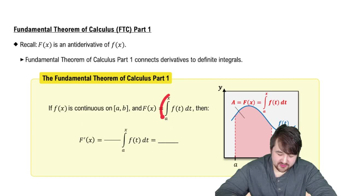
Fundamental Theorem of Calculus

The Fundamental Theorem of Calculus links differentiation and integration, stating that if F is an antiderivative of f on an interval [a, b], then the definite integral of f from a to b is F(b) - F(a). This theorem allows us to evaluate H(𝓍) by finding an antiderivative of the integrand and substituting the limits of integration.
Video consigliato:
Percorso guidato
06:11
Fundamental Theorem of Calculus Part 1

Geometric Interpretation of Integrals

Integrals can be interpreted geometrically as the area under a curve. For the function √(4 - t²), which describes a semicircle, the integral from 0 to 𝓍 gives the area of the corresponding segment of the semicircle. Understanding this geometric interpretation aids in visualizing the result of the integral and its evaluation at specific points like H(0).
Video consigliato:
04:18
Geometric Sequences - Recursive Formula
Pratica correlata
Domanda del libro di testo

Velocity to displacement An object travels on the 𝓍-axis with a velocity given by v(t) = 2t + 5, for 0 ≤ t ≤ 4.


(a) How far does the object travel, for 0 ≤ t ≤ 4 ?

81
views

Domanda del libro di testo

Area by geometry Use geometry to evaluate the following definite integrals, where the graph of ƒ is given in the figure.

(a) ∫₀⁴ ƒ(𝓍) d𝓍

96
views
Domanda del libro di testo

Use geometry and properties of integrals to evaluate the following definite integrals.

∫₄⁰ (2𝓍 + √(16―𝓍²)) d𝓍 . (Hint: Write the integral as sum of two integrals.)

114
views
Domanda del libro di testo

Evaluating integrals Evaluate the following integrals.


∫π/₁₂^π/⁹ (csc 3𝓍 cot 3𝓍 + sec 3𝓍 tan 3𝓍) d𝓍

42
views
Domanda del libro di testo

Evaluating integrals Evaluate the following integrals.                                                                                                                                         


 ∫ y² /(y³ + 27) dy

70
views
Domanda del libro di testo

Explain why or why not Determine whether the following statements are true and give an explanation or counterexample. Assume ƒ and ƒ' are continuous functions for all real numbers.

(f) ∫ₐᵇ (2 ƒ(𝓍) ―3g (𝓍)) d𝓍 = 2 ∫ₐᵇ ƒ(𝓍) d𝓍 + 3 ∫₆ᵃ g(𝓍) d𝓍 .

37
views