Ch. 5 - Integration
Briggs - Calculus: Early Transcendentals 3rd Edition
Briggs3rd EditionCalculus: Early TranscendentalsISBN: 9780136847243Non è quello che usi tu?Cambia libro di testo
Capitolo 5, Problema 5.1.47b

Sigma notation Express the following sums using sigma notation. (Answers are not unique.)
(b) 4 + 5 + 6 + 7 + 8 + 9

Guida verificata passo dopo passo
1
Step 1: Understand the problem. The goal is to express the sum 4 + 5 + 6 + 7 + 8 + 9 using sigma notation, which is a compact way to represent summation.
Step 2: Identify the pattern in the sequence. The numbers in the sum are consecutive integers starting from 4 and ending at 9.
Step 3: Define the general term of the sequence. The general term can be written as k, where k represents each integer in the sequence.
Step 4: Determine the range of the index. The sequence starts at 4 and ends at 9, so the index k will range from 4 to 9.
Step 5: Write the sum in sigma notation. The sum can be expressed as ∑kk=4...9.

Risposta video verificata per un problema simile:

Questa soluzione video è stata consigliata dai nostri tutor come utile per risolvere questo problema.
Durata del video:
1m

Concetti chiave

Ecco i concetti essenziali che devi comprendere per rispondere correttamente alla domanda.

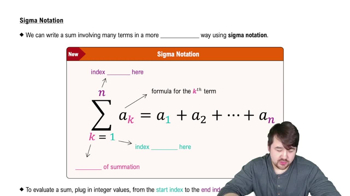
Sigma Notation

Sigma notation is a concise way to represent the sum of a sequence of numbers. It uses the Greek letter sigma (Σ) to indicate summation, followed by an expression that defines the terms to be added. The notation typically includes an index of summation, which specifies the starting and ending values for the variable that represents the terms in the sum.
Video consigliato:

Index of Summation

The index of summation is a variable used in sigma notation to denote the position of each term in the sequence being summed. It usually starts at a specified lower limit and increments by one until it reaches an upper limit. For example, in the sum Σ from i=1 to n, 'i' is the index that takes on integer values from 1 to n, allowing for the systematic addition of terms.
Video consigliato:

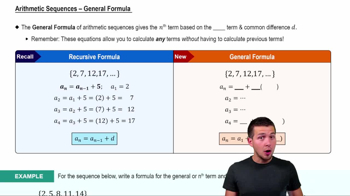
Arithmetic Sequence

An arithmetic sequence is a sequence of numbers in which the difference between consecutive terms is constant. In the case of the sum 4 + 5 + 6 + 7 + 8 + 9, the common difference is 1. Recognizing that the terms form an arithmetic sequence helps in expressing the sum using sigma notation, as it allows for a general formula to represent the terms based on their position in the sequence.
Video consigliato:
5:17
Arithmetic Sequences - General Formula
Pratica correlata
Domanda del libro di testo

Sigma notation Evaluate the following expressions.                                                                                                                                          

(b)    10                                                                                                                                                                               

       ∑  (2κ + 1)                                                                                                                                                                          

       κ=1                         

83
views

Domanda del libro di testo

Displacement from a table of velocities The velocities (in mi/hr) of an automobile moving along a straight highway over a two-hour period are given in the following table.

(b) Find the midpoint Riemann sum approximation to the displacement on [0,2] with n = 2 and .n = 4 .

67
views
Domanda del libro di testo

{Use of Tech} Functions defined by integrals Consider the function g, which is given in terms of a definite integral with a variable upper limit.

b) Calculate g'(𝓍)


g(𝓍) = ∫₀ˣ sin² t dt

65
views
Domanda del libro di testo

{Use of Tech} Riemann sums for larger values of n Complete the following steps for the given function f and interval.


ƒ(𝓍) = x² ― 1 on [2,5] ; n = 75

(b) Based on the approximations found in part (a), estimate the area of the region bounded by the graph of f and the x-axis on the interval.

88
views
Domanda del libro di testo

Explain why or why not Determine whether the following statements are true and give an explanation or counterexample.

(b) A left Riemann sum always overestimates the area of a region bounded by a positive increasing function and the x-axis on an interval [a,b].

81
views
Domanda del libro di testo

{Use of Tech} Approximating net area The following functions are positive and negative on the given interval.


ƒ(x) = 4 - 2x on [0,4]


(b) Approximate the net area bounded by the graph of f and the x-axis on the interval using a left, right, and midpoint Riemann sum with n = 4.

48
views