Ch. 5 - Integration
Briggs - Calculus: Early Transcendentals 3rd Edition
Briggs3rd EditionCalculus: Early TranscendentalsISBN: 9780136847243Non è quello che usi tu?Cambia libro di testo
Capitolo 5, Problema 5.2.67

Use geometry and properties of integrals to evaluate


∫₀¹ (2𝓍 + √(1―𝓍²) + 1) d𝓍

Guida verificata passo dopo passo
1
Step 1: Break the integral into separate terms using the property of integrals: ∫ₐᵇ [f(𝓍) + g(𝓍) + h(𝓍)] d𝓍 = ∫ₐᵇ f(𝓍) d𝓍 + ∫ₐᵇ g(𝓍) d𝓍 + ∫ₐᵇ h(𝓍) d𝓍. This gives ∫₀¹ (2𝓍 + √(1―𝓍²) + 1) d𝓍 = ∫₀¹ 2𝓍 d𝓍 + ∫₀¹ √(1―𝓍²) d𝓍 + ∫₀¹ 1 d𝓍.
Step 2: Evaluate ∫₀¹ 2𝓍 d𝓍. Use the power rule for integration: ∫ 𝓍ⁿ d𝓍 = (𝓍ⁿ⁺¹)/(n+1) + C. Here, n = 1, so ∫ 2𝓍 d𝓍 = 2 * (𝓍²/2) = 𝓍². Apply the limits of integration from 0 to 1.
Step 3: Evaluate ∫₀¹ √(1―𝓍²) d𝓍. Recognize that √(1―𝓍²) represents the equation of a semicircle with radius 1 centered at the origin. The integral ∫₀¹ √(1―𝓍²) d𝓍 calculates the area of one-quarter of the circle. Use the formula for the area of a circle, A = πr², and divide by 4.
Step 4: Evaluate ∫₀¹ 1 d𝓍. The integral of a constant c over [a, b] is given by c(b―a). Here, c = 1, a = 0, and b = 1, so ∫₀¹ 1 d𝓍 = 1 * (1―0).
Step 5: Combine the results from Steps 2, 3, and 4. Add the values obtained for ∫₀¹ 2𝓍 d𝓍, ∫₀¹ √(1―𝓍²) d𝓍, and ∫₀¹ 1 d𝓍 to get the final result of the integral.

Risposta video verificata per un problema simile:

Questa soluzione video è stata consigliata dai nostri tutor come utile per risolvere questo problema.
Durata del video:
2m

Concetti chiave

Ecco i concetti essenziali che devi comprendere per rispondere correttamente alla domanda.

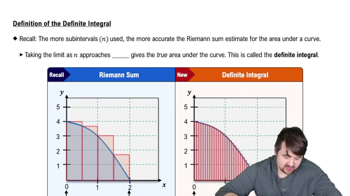
Definite Integrals

A definite integral represents the signed area under a curve between two points on the x-axis. It is denoted as ∫_a^b f(x) dx, where 'a' and 'b' are the limits of integration. The value of a definite integral can be interpreted geometrically as the accumulation of the area between the function f(x) and the x-axis from x = a to x = b.
Video consigliato:
Percorso guidato
05:43
Definition of the Definite Integral

Properties of Integrals

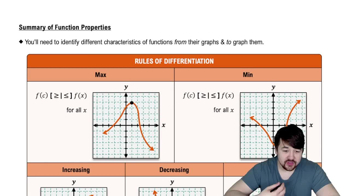
Properties of integrals, such as linearity, allow us to break down complex integrals into simpler parts. For example, ∫(f(x) + g(x)) dx = ∫f(x) dx + ∫g(x) dx. This property is particularly useful when evaluating integrals that consist of multiple terms, as it enables the evaluation of each term separately.
Video consigliato:
Percorso guidato
06:21
Properties of Functions

Geometric Interpretation of Functions

Understanding the geometric interpretation of functions is crucial for evaluating integrals. For instance, the term √(1 - x²) represents a semicircle with radius 1. Recognizing the shapes formed by the functions involved can simplify the evaluation of the integral by allowing the use of geometric area formulas instead of purely algebraic methods.
Video consigliato:
04:18
Geometric Sequences - Recursive Formula
Pratica correlata
Domanda del libro di testo

Indefinite integrals Use a change of variables or Table 5.6 to evaluate the following indefinite integrals. Check your work by differentiating.                                                                                  


 ∫ sin 𝓍 sec⁸ 𝓍 d𝓍

69
views
Domanda del libro di testo

Definite integrals Use a change of variables or Table 5.6 to evaluate the following definite integrals.                                                                                                                         


 ∫₀¹ 2e²ˣ d𝓍

74
views
Domanda del libro di testo

Definite integrals Use a change of variables or Table 5.6 to evaluate the following definite integrals.                                                                                                                         


 ∫₀ᵉ² (ln p)/p dp

76
views
Domanda del libro di testo

Average height of a wave The surface of a water wave is described by y = 5 (1 + cos 𝓍) , for ― π ≤ 𝓍 ≤ π, where y = 0 corresponds to a trough of the wave (see figure). Find the average height of the wave above the trough on [ ―π , π] .

65
views
Domanda del libro di testo

Areas of regions Find the area of the region bounded by the graph of ƒ and the 𝓍-axis on the given interval.


ƒ(𝓍) = 𝓍³ ― 1 on [―1, 2]

102
views
Domanda del libro di testo

Cubic zero net area Consider the graph of the cubic y = 𝓍 (𝓍― a) (𝓍― b), where 0 < a < b. Verify that the graph bounds a region above the 𝓍-axis, for 0 < 𝓍 < a , and bounds a region below the 𝓍-axis, for a < 𝓍 < b. What is the relationship between a and b if the areas of these two regions are equal? 

35
views