Ch. 5 - Integration
Briggs - Calculus: Early Transcendentals 3rd Edition
Briggs3rd EditionCalculus: Early TranscendentalsISBN: 9780136847243Non è quello che usi tu?Cambia libro di testo
Capitolo 5, Problema 5.3.106

{Use of Tech} Areas of regions Find the area of the region 𝑅 bounded by the graph of ƒ and the 𝓍-axis on the given interval. Graph ƒ and show the region 𝑅.                                              
                                                                                                                                                                                    
 ƒ(𝓍) = 𝓍² (𝓍 ― 2) on [ ―1 , 3]

Guida verificata passo dopo passo
1
First, understand that the region \( R \) is bounded by the graph of the function \( f(x) = x^{2}(x - 2) \) and the x-axis over the interval \( [-1, 3] \). Our goal is to find the total area between the curve and the x-axis on this interval.
Next, find the points where the graph intersects the x-axis within the interval. These are the roots of \( f(x) = 0 \). Solve \( x^{2}(x - 2) = 0 \) to find these points.
Once the roots are identified, split the interval \( [-1, 3] \) into subintervals based on these roots. This is important because the function may be above or below the x-axis on different subintervals, and the area calculation requires considering the absolute value of the integral on each subinterval.
Set up the definite integrals for each subinterval, integrating \( |f(x)| \) with respect to \( x \). This means you will integrate \( f(x) \) where it is positive and \( -f(x) \) where it is negative to ensure the area is positive.
Finally, compute each integral separately and sum their absolute values to find the total area of the region \( R \). Remember, the area is the sum of the magnitudes of these integrals, not just their algebraic sum.

Risposta video verificata per un problema simile:

Questa soluzione video è stata consigliata dai nostri tutor come utile per risolvere questo problema.
Durata del video:
3m

Concetti chiave

Ecco i concetti essenziali che devi comprendere per rispondere correttamente alla domanda.

Definite Integral and Area Under a Curve

The definite integral of a function over an interval represents the net area between the graph of the function and the x-axis. When the function is positive, the integral gives the area above the x-axis; when negative, it subtracts area below the x-axis. To find the total area of a region bounded by the curve and the x-axis, one often integrates the absolute value of the function or splits the integral at points where the function crosses the axis.
Video consigliato:
Percorso guidato
05:43
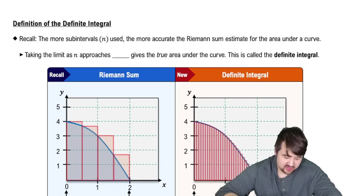
Definition of the Definite Integral

Finding Zeros of the Function

Identifying where the function equals zero within the given interval is crucial because these points mark where the graph intersects the x-axis. These zeros divide the interval into subintervals where the function maintains a consistent sign (positive or negative). This helps in correctly calculating areas by integrating over each subinterval and taking absolute values if necessary.
Video consigliato:
6:37
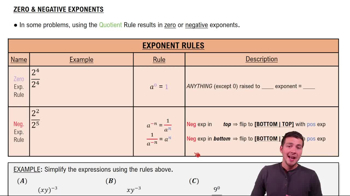
Zero and Negative Rules

Graphing the Function to Visualize the Region

Sketching or graphing the function over the specified interval helps visualize the region bounded by the curve and the x-axis. It reveals where the function is above or below the axis, the shape of the region, and the points of intersection. This visual aid is essential for setting up the integral correctly and understanding the problem context.
Video consigliato:
Percorso guidato
5:53
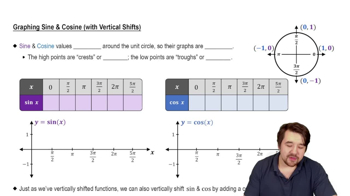
Graph of Sine and Cosine Function
Pratica correlata
Domanda del libro di testo

Area by geometry Use geometry to evaluate the following integrals.


∫⁴₋₆ √(24 ― 2𝓍 ― 𝓍²) d𝓍

82
views

Domanda del libro di testo

Integrals with sin² 𝓍 and cos² 𝓍 Evaluate the following integrals.                                                                                                             


 ∫₋π^π cos² 𝓍 d𝓍

56
views
Domanda del libro di testo

On which derivative rule is the Substitution Rule based?

89
views
Domanda del libro di testo

Symmetry in integrals Use symmetry to evaluate the following integrals.

∫₋π/₄^π/⁴ sec² x dx

95
views
Domanda del libro di testo

Indefinite integrals Use a change of variables or Table 5.6 to evaluate the following indefinite integrals. Check your work by differentiating.                                                                                  


 ∫ d𝓍 / (√1 ― 9𝓍²)

92
views
Domanda del libro di testo

Symmetry in integrals Use symmetry to evaluate the following integrals.

∫₋π/₂^π/² 5 sin θ dθ

245
views