Ch. 5 - Integration
Briggs - Calculus: Early Transcendentals 3rd Edition
Briggs3rd EditionCalculus: Early TranscendentalsISBN: 9780136847243Non è quello che usi tu?Cambia libro di testo
Capitolo 5, Problema 5.R.96c

Velocity to displacement An object travels on the 𝓍-axis with a velocity given by v(t) = 2t + 5, for 0 ≤ t ≤ 4.


(c) True or false: The object would travel as far as in part (a) if it traveled at its average velocity (a constant), for 0 ≤ t ≤ 4. .

Guida verificata passo dopo passo
1
Step 1: Understand the problem. The velocity function v(t) = 2t + 5 represents the instantaneous velocity of the object at time t. To determine if the object would travel the same distance at its average velocity, we need to compare the displacement using the instantaneous velocity and the displacement using the average velocity.
Step 2: Calculate the displacement using the instantaneous velocity. Displacement is the integral of velocity over time. Set up the integral: ∫[0 to 4] v(t) dt = ∫[0 to 4] (2t + 5) dt. Use the rules of integration to compute this integral.
Step 3: Find the average velocity. The average velocity over the interval [0, 4] is given by the formula: v_avg = (1 / (b - a)) ∫[a to b] v(t) dt, where a = 0 and b = 4. Substitute the values and compute the average velocity.
Step 4: Calculate the displacement using the average velocity. Displacement at constant velocity is given by: displacement = v_avg × time. Multiply the average velocity by the total time interval (4 seconds).
Step 5: Compare the two displacements. If the displacement calculated using the instantaneous velocity matches the displacement calculated using the average velocity, the statement is true. Otherwise, it is false.

Risposta video verificata per un problema simile:

Questa soluzione video è stata consigliata dai nostri tutor come utile per risolvere questo problema.
Durata del video:
2m

Concetti chiave

Ecco i concetti essenziali che devi comprendere per rispondere correttamente alla domanda.

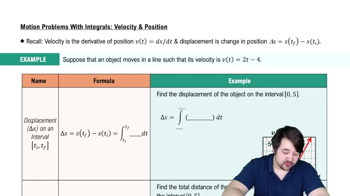
Velocity and Displacement

Velocity is the rate of change of displacement with respect to time, indicating how fast an object is moving and in which direction. Displacement, on the other hand, is the overall change in position of the object. Understanding the relationship between these two concepts is crucial for analyzing motion, as displacement can be calculated by integrating the velocity function over a given time interval.
Video consigliato:
Percorso guidato
10:17
Using The Velocity Function

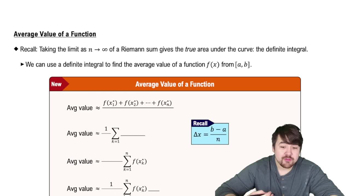
Average Velocity

Average velocity is defined as the total displacement divided by the total time taken. It represents a constant velocity that would result in the same displacement as the actual varying velocity over a specific time interval. In this context, calculating the average velocity over the interval from t = 0 to t = 4 is essential to determine if the object would travel the same distance as when using the instantaneous velocity function.
Video consigliato:
Percorso guidato
06:37
Average Value of a Function

Integration

Integration is a fundamental concept in calculus used to find the area under a curve, which in the context of motion, corresponds to calculating displacement from a velocity function. By integrating the velocity function v(t) = 2t + 5 over the interval [0, 4], one can determine the total displacement of the object. This process is key to answering questions about the distance traveled by the object during the specified time period.
Video consigliato:
Percorso guidato
06:18
Integration by Parts for Definite Integrals
Pratica correlata
Domanda del libro di testo

Area by geometry Use geometry to evaluate the following definite integrals, where the graph of ƒ is given in the figure.

(b) ∫₆⁴ ƒ(𝓍) d𝓍

150
views

Domanda del libro di testo

Limit definition of the definite integral Use the limit definition of the definite integral with right Riemann sums and a regular partition to evaluate the following definite integrals. Use the Fundamental Theorem of Calculus to check your answer. 


∫₀⁴ (𝓍³―𝓍) d𝓍

96
views
Domanda del libro di testo

Explain why or why not Determine whether the following statements are true and give an explanation or counterexample. Assume ƒ and ƒ' are continuous functions for all real numbers.

(c) ∫ₐᵇ ƒ'(𝓍) d𝓍 = ƒ(b) ―ƒ(a) .

51
views
Domanda del libro di testo

Definite integrals Evaluate the following integrals using the Fundamental Theorem of Calculus. Explain why your result is consistent with the figure.


∫₀¹ (𝓍² ― 2𝓍 + 3) d𝓍


132
views
Domanda del libro di testo

Explain why or why not Determine whether the following statements are true and give an explanation or counterexample. Assume ƒ and ƒ' are continuous functions for all real numbers.

(d) If ƒ is continuous on [a,b] and ∫ₐᵇ |ƒ(𝓍)| d𝓍 = 0 , then ƒ(𝓍) = 0 on [a,b] .

64
views
Domanda del libro di testo

Displacement from velocity A particle moves along a line with a velocity given by v(t) = 5 sin πt, starting with an initial position s(0) = 0 . Find the displacement of the particle between t = 0 and t = 2 , which is given by s(t) = ∫₀² v(t) dt . Find the distance traveled by the particle during this interval, which is ∫₀² |v(t)| dt .

195
views